






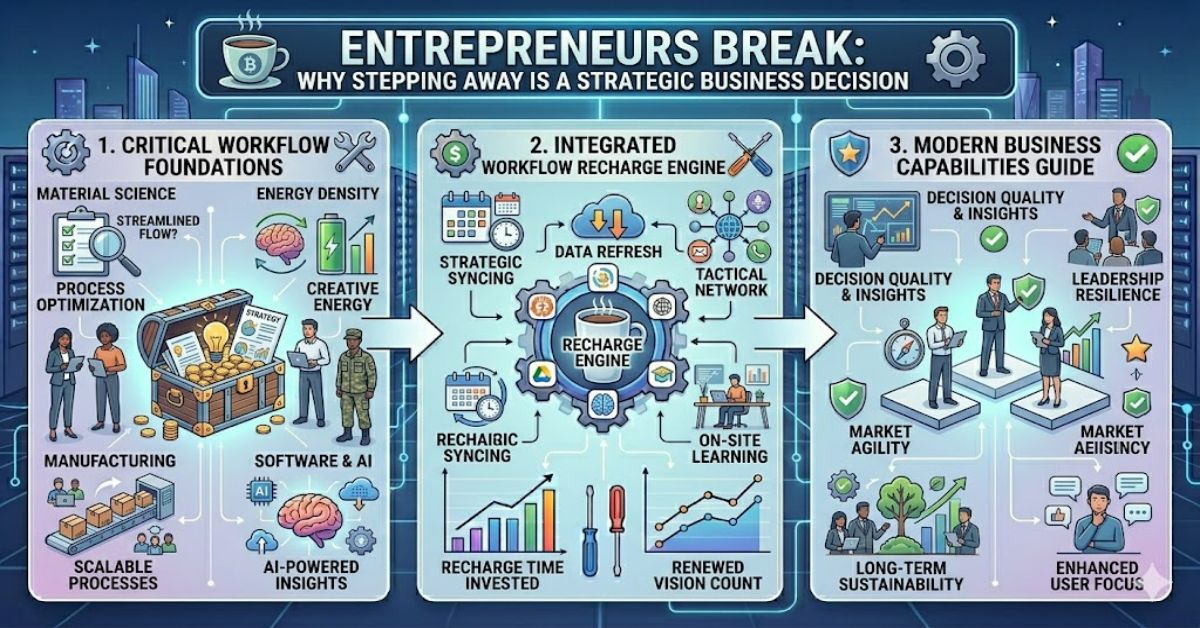
The idea of an entrepreneurs break is often misunderstood. Many founders see downtime as a luxury reserved for people with less responsibility. Yet evidence from entrepreneurship, psychology, and organizational research suggests the opposite. Taking intentional breaks is a strategic necessity for entrepreneurs, not a luxury.
Entrepreneurs face constant decision-making demands. They manage finances, operations, hiring, marketing, customer relationships, and long-term strategy—often simultaneously. Over time, this creates decision fatigue, mental exhaustion, and declining cognitive performance. Research published in 2024 found that entrepreneurial stress significantly affects mental health and business outcomes, while effective stress-management practices improve performance and resilience.
The most effective founders are not necessarily the people who work the longest hours. They are often the people who know when to step back, reset their thinking, and return with clarity. A well-timed break can prevent burnout, improve focus, and create space for better strategic decisions.
This article examines why intentional recovery matters, the business risks of constant work, the evidence behind entrepreneurial well-being, and how founders can integrate recovery into a sustainable growth strategy.
The Modern Entrepreneur’s Productivity Trap
Entrepreneurship rewards initiative, persistence, and personal accountability. Those same strengths can become liabilities when founders begin equating constant activity with meaningful progress.
Many entrepreneurs operate under three assumptions:
- More hours produce better outcomes.
- Rest can wait until success arrives.
- Slowing down creates competitive disadvantage.
In reality, performance follows a different pattern.
As mental resources decline, productivity often appears high while effectiveness falls. Entrepreneurs continue working but spend more time revisiting decisions, fixing mistakes, or responding emotionally to problems.
Signs the Productivity Trap Is Taking Hold
| Warning Sign | Business Impact |
| Constant task switching | Reduced focus and execution quality |
| Delayed decisions | Lost opportunities |
| Increased irritability | Team and customer friction |
| Mental exhaustion | Lower creativity |
| Poor sleep quality | Reduced cognitive performance |
| Difficulty prioritizing | Strategic drift |
The challenge is that these symptoms emerge gradually. Many founders recognize burnout only after performance has already declined.
Research reviewing entrepreneurial burnout highlights that chronic stress can undermine both founder well-being and business sustainability.
Why Decision Fatigue Makes Breaks Essential
Every business decision consumes cognitive resources.
Entrepreneurs make hundreds of decisions each week, ranging from pricing strategies to hiring choices and marketing budgets. While each decision may seem manageable, their cumulative effect creates mental fatigue.
A 2024 study examining daily time pressure among entrepreneurs found that sustained pressure contributes to fatigue and emotional strain.
What Decision Fatigue Looks Like
When decision fatigue develops, founders often:
- Delay important choices
- Default to familiar options
- Become overly risk-averse
- Overanalyze simple issues
- React emotionally rather than strategically
An intentional break interrupts this cycle.
Stepping away temporarily allows the brain to recover cognitive capacity. When founders return, they frequently report improved clarity and faster decision-making.
This explains why some business breakthroughs occur during walks, vacations, workouts, or periods away from active work rather than during marathon work sessions.
How Breaks Improve Creative Problem-Solving
Creativity is often treated as inspiration. In reality, it is closely connected to recovery.
When entrepreneurs remain immersed in operational problems for extended periods, thinking becomes narrow and repetitive. Breaks create psychological distance from those problems.
This distance allows the brain’s associative networks to connect ideas that may not emerge during focused work.
Common Recovery Activities That Support Creativity
| Recovery Activity | Potential Benefit |
| Walking outdoors | Improved divergent thinking |
| Exercise | Enhanced cognitive flexibility |
| Travel | Exposure to new perspectives |
| Reading outside one’s industry | Cross-disciplinary insight |
| Unstructured personal time | Reduced cognitive overload |
| Hobbies | Mental recovery and idea generation |
Many successful founders report that their most valuable insights emerged after stepping away from immediate business pressures rather than pushing through them.
The Burnout Risk Entrepreneurs Often Ignore
Burnout is more than feeling tired.
It is a state of emotional exhaustion, reduced motivation, and declining effectiveness caused by prolonged stress exposure.
Entrepreneurship research increasingly identifies burnout as a major threat to founder performance and business continuity.
Real-World Example: The Startup Founder Cycle
A common pattern appears across early-stage companies:
- Founder works excessively during launch.
- Initial growth creates additional demands.
- Recovery time decreases.
- Stress accumulates.
- Decision quality falls.
- Business challenges increase.
- Founder works even harder to compensate.
Without intervention, the cycle becomes self-reinforcing.
Research examining entrepreneurial stress found that proactive coping and stress-management practices can reduce mental exhaustion and improve outcomes.
Original Insight #1
Many founders treat burnout as an individual health issue. In practice, it is often a business systems problem. Poor delegation, unclear processes, and excessive founder dependence frequently create the conditions that make recovery difficult.
Strategic Implications of Regular Recovery
The strongest argument for intentional breaks is not wellness—it is business performance.
A founder’s mental state influences:
- Capital allocation
- Hiring decisions
- Product strategy
- Customer relationships
- Risk assessment
- Crisis management
Each area carries financial consequences.
Comparing Short-Term Hustle vs Sustainable Performance
| Factor | Constant Work Mode | Strategic Recovery Mode |
| Decision quality | Declines over time | More consistent |
| Creativity | Reduced | Higher |
| Stress levels | Elevated | Managed |
| Team leadership | Reactive | Deliberate |
| Long-term energy | Depleting | Sustainable |
| Business resilience | Lower | Higher |
Original Insight #2
Recovery functions like preventive maintenance. Businesses budget for software updates, equipment maintenance, and compliance reviews. Few allocate time for founder recovery despite the founder being the most critical operating asset.
What Entrepreneurs Are Saying
Community discussions among founders consistently reveal a common theme: many recognize the need for breaks but struggle to take them.
Entrepreneurs frequently describe fears that stepping away could slow progress or create business setbacks. Others report that taking time away improved focus, reduced mental fog, and helped them return with better priorities.
One recurring observation from entrepreneurial communities is that recovery often restores perspective, helping founders distinguish urgent tasks from merely noisy ones.
These experiences align with academic findings linking stress management and well-being to entrepreneurial performance.
Risks and Trade-Offs of Taking a Break
Breaks are valuable, but they are not without challenges.
Entrepreneurs face legitimate concerns:
- Revenue responsibilities
- Client commitments
- Investor expectations
- Small team capacity
- Operational dependencies
The goal is not unlimited downtime.
The goal is intentional recovery.
Potential Risks
| Risk | Mitigation Strategy |
| Operational delays | Build systems and delegation |
| Missed opportunities | Create escalation protocols |
| Client concerns | Communicate availability clearly |
| Team uncertainty | Establish decision frameworks |
Original Insight #3
The biggest risk is not taking a break. Many founders calculate the short-term cost of stepping away but fail to calculate the long-term cost of poor decisions made while exhausted.
Market and Cultural Impact
Entrepreneurial culture has historically celebrated overwork.
The startup ecosystem often rewards stories of all-night work sessions and extreme sacrifice. While perseverance remains important, the conversation is shifting.
Recent research increasingly focuses on entrepreneurial well-being, resilience, and sustainable performance rather than pure workload intensity.
This shift reflects broader economic realities:
- Founder burnout affects company survival.
- Mental health influences innovation.
- Talent retention depends on leadership quality.
- Investors increasingly evaluate founder sustainability.
Organizations that normalize recovery may gain competitive advantages through stronger leadership consistency.
Building a Practical Recovery System
The most effective entrepreneurs do not wait until exhaustion appears.
They build recovery into their operating model.
Weekly Practices
- One technology-free block each week
- Scheduled strategic thinking time
- Exercise and physical movement
- Protected sleep routines
Monthly Practices
- Half-day reflection sessions
- Performance reviews focused on energy, not only revenue
- Process audits to reduce founder dependency
Quarterly Practices
- Extended breaks
- Strategic planning retreats
- Goal reassessment
Recovery becomes most effective when it is scheduled rather than earned.
The Future of Entrepreneurs Break in 2027
By 2027, founder well-being is likely to become a more formal business metric.
Several trends support this direction:
- Growing academic research on entrepreneurial stress and burnout.
- Increased awareness of mental-health impacts on business outcomes.
- Expansion of AI and automation tools that reduce operational workloads.
- Greater investor focus on founder resilience and leadership sustainability.
However, uncertainty remains.
Some entrepreneurial cultures will continue rewarding extreme work habits. Others will increasingly recognize recovery as a competitive advantage.
The most likely outcome is a hybrid model where high performance and intentional recovery become complementary rather than opposing concepts.
Key Takeaways
- Intentional recovery supports better decision-making and strategic clarity.
- Decision fatigue can silently reduce business performance.
- Creative breakthroughs often emerge during periods away from active work.
- Burnout is frequently a systems issue rather than a personal weakness.
- Sustainable entrepreneurship depends on managing energy alongside time.
- Recovery should be scheduled proactively rather than used only during crises.
- Founder well-being increasingly influences long-term company success.
Conclusion
An effective entrepreneurs break is not about avoiding work. It is about preserving the mental capacity required to do important work well.
Entrepreneurs operate in environments defined by uncertainty, responsibility, and constant decision-making. Those demands make recovery more valuable, not less. Research continues to show connections between stress management, well-being, and entrepreneurial performance, while founder experiences consistently highlight the benefits of stepping back when pressure becomes overwhelming.
The strongest businesses are rarely built through exhaustion alone. They are built through sustained execution, thoughtful decision-making, and the ability to adapt over long periods.
Taking intentional entrepreneurs break helps make all three possible.
For founders focused on long-term success, recovery is not separate from performance. It is part of the strategy.
FAQ
What is an entrepreneurs break?
An entrepreneurs break is intentional time away from daily business demands designed to restore mental energy, improve focus, and reduce decision fatigue.
How often should entrepreneurs take breaks?
Short daily recovery periods, weekly downtime, and quarterly extended breaks are common approaches. The ideal schedule depends on workload, business stage, and personal capacity.
Can taking entrepreneurs break improve business performance?
Yes. Research links stress management and well-being to stronger performance, decision-making, and resilience among entrepreneurs.
What are the signs of entrepreneurs break?
Common indicators include mental exhaustion, poor focus, irritability, declining creativity, sleep disruption, and difficulty making decisions.
Is burnout common among founders?
Yes. Entrepreneurial burnout has become a significant research focus due to its impact on both founder well-being and business sustainability.
Are long vacations necessary?
Not always. Short, intentional recovery periods can be highly effective when practiced consistently.
How do breaks help creativity?
Distance from operational challenges allows the brain to process information differently, often leading to fresh perspectives and innovative solutions.
Methodology
This analysis was developed using peer-reviewed entrepreneurship research, academic journals, founder community discussions, and recent studies on entrepreneurial stress, burnout, resilience, and well-being published between 2023 and 2025.
Sources were selected based on relevance to entrepreneurial performance, mental health, and recovery practices. The article combines research findings with documented founder experiences to provide a balanced perspective.
Limitations include variations in business size, industry, geography, and founder personality. Recovery strategies that work for one entrepreneur may require adjustment for another. Where future trends are discussed, they are based on observable research and market developments rather than predictions presented as certainty.
References
Barbosa, R. M. A., Pérez-Nebra, A. R., Villajos, E., & González-Ladrón-De-Guevara, F. (2024). The entrepreneur’s well-being: Current state of the literature and main theories. Journal of Global Entrepreneurship Research, 14(46).
Delladio, S., & Caputo, A. (2025). When the tank is empty: Reviewing burnout in entrepreneurship. Journal of Small Business Management, 63(5), 2320–2356.
Kiefl, S., Fischer, S., & Schmitt, J. (2024). Self-employed and stressed out? The impact of stress and stress management on entrepreneurs’ mental health and performance. Frontiers in Psychology, 15, 1365489.
Sinha, R. S., & Veettil, N. M. K. (2024). How does daily time pressure fatigue entrepreneurs? The paradoxical effects of growth mindset. Academy of Management Proceedings, 2024(1).
Van der Zwan, P., Hessels, J., & Rietveld, C. A. (2024). I want it all: Exploring the relationship between entrepreneurs’ satisfaction with work-life balance, well-being, flow and firm growth. Review of Managerial Science, 18, 799–826.
Wach, D., Schermuly, C. C., Kirschbaum, C., & Wegge, J. (2025). How stressful is firm insolvency? Self-reported, biological, and physiological indicators of entrepreneurs’ well-being. Strategic Entrepreneurship Journal.