










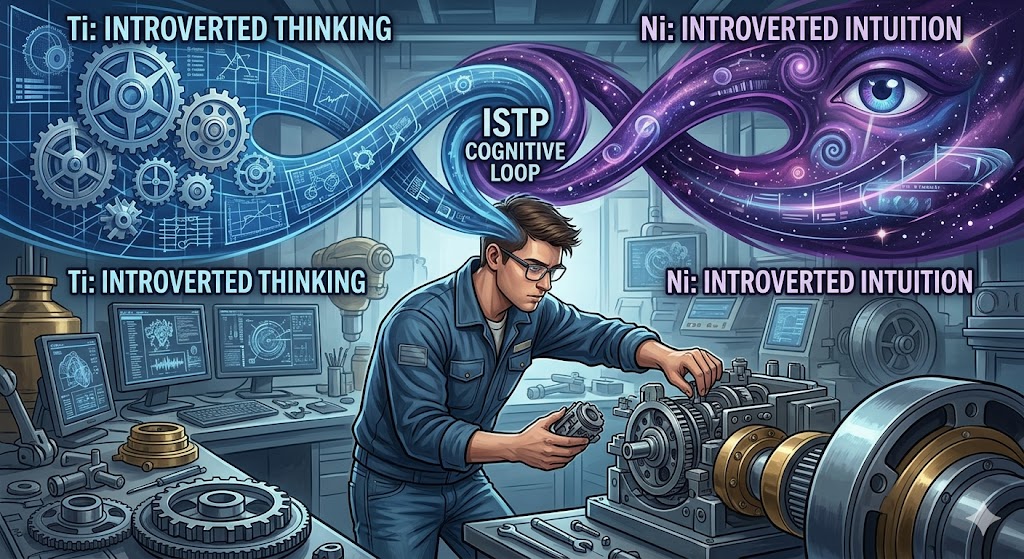
If you have searched for ti-ni, you have likely encountered discussions describing an ISTP who becomes trapped inside their own mind. According to Jungian cognitive-function theory and modern MBTI interpretations, the Ti-Ni loop occurs when an ISTP relies heavily on Introverted Thinking (Ti) and Introverted Intuition (Ni) while bypassing their auxiliary function, Extraverted Sensing (Se).
The result is often described as a cycle of over-analysis, prediction, and internal theorising. Instead of gathering new information from the outside world, the individual repeatedly revisits existing conclusions and assumptions. Many personality enthusiasts describe this state as feeling detached, withdrawn, and mentally exhausted.
It is important to clarify that the Ti-Ni loop is not recognised as a clinical mental health condition. Rather, it is a model used within the MBTI and Jungian personality communities to explain certain behavioural patterns. Like many typology concepts, its value depends on whether individuals find it useful as a framework for self-reflection.
Understanding the loop requires understanding the functions involved, how they normally interact, and why imbalance can create practical difficulties in everyday life.
What Is the Ti-Ni Loop?
In the Myers-Briggs framework, the ISTP cognitive stack is commonly presented as:
| Function Order | Function | Role |
| Dominant | Introverted Thinking (Ti) | Internal logic and analysis |
| Auxiliary | Extraverted Sensing (Se) | Real-time observation and action |
| Tertiary | Introverted Intuition (Ni) | Pattern recognition and forecasting |
| Inferior | Extraverted Feeling (Fe) | Social connection and values |
Under healthy circumstances, Ti analyses information while Se continually gathers new data from the environment.
The loop begins when Se becomes neglected. Instead of testing ideas against reality, the individual alternates between analysis (Ti) and interpretation (Ni).
This creates a closed system where assumptions are rarely challenged.
How the Loop Typically Develops
Several situations may contribute to the pattern:
Stress
Periods of prolonged stress often encourage people to retreat into familiar mental habits.
Isolation
Without regular engagement with people, activities, or changing environments, external feedback decreases.
Fear of Failure
Some individuals become reluctant to act until every possibility has been analysed.
Information Saturation
Paradoxically, consuming large amounts of information online can reduce real-world experimentation.
Instead of taking action, a person continues researching and theorising.
Signs of a Ti-Ni Loop
Although experiences differ, common descriptions include:
| Common Behaviour | Possible Effect |
| Endless analysis | Difficulty making decisions |
| Predicting negative outcomes | Increased pessimism |
| Reduced social interaction | Isolation |
| Avoiding practical action | Stalled progress |
| Obsessive pattern-seeking | Confirmation bias |
| Excessive self-reflection | Mental fatigue |
One of the hidden dangers is that the loop can feel productive. Thinking intensely often creates the impression that progress is being made, even when no external action occurs.
Why Extraverted Sensing Matters
Many online explanations focus on Ti and Ni while overlooking the importance of Se.
For ISTPs, Se acts as a reality-testing mechanism.
It encourages:
- Direct observation
- Physical engagement
- Experimentation
- Adaptability
- Immediate feedback
Without Se, theories remain untested.
A practical example illustrates this clearly. An ISTP considering a career change may spend weeks analysing possibilities and predicting outcomes. Healthy Se engagement would involve conducting interviews, trying new projects, or speaking with professionals. The loop prevents that step from occurring.
The Difference Between Reflection and Rumination
A common misconception is that all introspection is unhealthy.
Reflection can be valuable.
Rumination becomes problematic when thoughts repeatedly circle without generating action or insight.
Healthy Reflection
- Leads to decisions
- Produces learning
- Encourages growth
- Incorporates new information
Unhealthy Rumination
- Repeats identical concerns
- Reinforces existing beliefs
- Avoids uncertainty
- Delays action
This distinction is one of the most useful practical insights missing from many discussions of the Ti-Ni pattern.
Real-World Implications
The effects can appear in several areas of life.
Career Development
Professionals may overanalyse opportunities instead of pursuing them.
Relationships
Partners sometimes perceive withdrawal as disinterest rather than internal processing.
Learning
Theoretical understanding grows while practical application stagnates.
Creativity
Ideas multiply, but completed projects become rare.
In each case, the issue is not intelligence or capability. The challenge lies in balancing thought with action.
Common Misunderstandings
The Loop Is Not an Official Diagnosis
No major psychological organisation recognises the Ti-Ni loop as a mental health condition.
Not Every ISTP Experiences It
Personality descriptions describe tendencies, not rules.
Other Types Can Show Similar Behaviour
Overthinking and withdrawal are common human experiences.
MBTI Has Scientific Limitations
Researchers have long debated the reliability and validity of personality type models. The framework remains popular for self-development but should not be confused with evidence-based clinical assessment.
Three Insights Often Missing From Online Discussions
1. The Loop Creates a Feedback Deficit
The greatest problem is not excessive thinking.
It is the absence of new external data.
Without fresh experiences, conclusions become increasingly difficult to challenge.
2. Action Often Solves What Analysis Cannot
Many perceived problems remain theoretical until tested.
A small experiment frequently provides more clarity than hours of contemplation.
3. Digital Environments Can Intensify the Pattern
Remote work, social media, and algorithm-driven content can create conditions where individuals consume information continuously without meaningful engagement.
This modern factor is rarely discussed despite its growing relevance.
The Future of Ti-Ni in 2027
By 2027, conversations surrounding cognitive functions are likely to continue expanding through online communities, personality platforms, and AI-driven self-assessment tools.
Several trends may influence discussion:
- Increased use of AI personality analysis tools
- Greater integration of behavioural data into self-assessment systems
- More criticism from evidence-based psychology researchers
- Growing demand for practical self-development applications
The most likely outcome is not the replacement of traditional personality frameworks but their coexistence with more scientifically grounded models such as the Five-Factor Model.
Individuals will increasingly seek tools that combine personal insight with measurable behavioural outcomes.
Key Takeaways
- The Ti-Ni loop describes an ISTP tendency toward excessive internal processing.
- Extraverted Sensing plays a crucial balancing role.
- The concept belongs to Jungian typology rather than clinical psychology.
- Real-world action provides an effective counterweight to over-analysis.
- Modern digital lifestyles may intensify loop-like behaviours.
- Reflection becomes problematic when it prevents experimentation and growth.
Conclusion
The concept of ti-ni remains one of the most discussed patterns within MBTI communities because it captures an experience many people recognise: becoming trapped in thought while remaining disconnected from action.
Whether one fully accepts Jungian cognitive functions or views them as useful metaphors, the core lesson has practical value. Analysis alone rarely produces complete understanding. Insight develops when ideas are tested against reality.
The Ti-Ni loop serves as a reminder that intellectual clarity and real-world engagement must work together. For ISTPs, that balance is often represented by the relationship between Ti and Se. When observation, experimentation, and experience are reintroduced, thinking becomes grounded rather than circular.
Viewed in this way, the concept is less about personality labels and more about a universal challenge: avoiding the temptation to live entirely inside our own assumptions.
FAQ
What does Ti-Ni mean in MBTI?
Ti-Ni refers to the interaction between Introverted Thinking and Introverted Intuition, often discussed in relation to the ISTP cognitive loop.
Is the Ti-Ni loop scientifically proven?
No. It is part of Jungian personality theory and MBTI interpretations rather than mainstream psychological science.
Can other personality types experience similar loops?
Yes. MBTI theory proposes different loop patterns for different types, though overthinking itself is common across all personalities.
How can someone break a Ti-Ni loop?
Many personality practitioners recommend engaging Extraverted Sensing through practical action, physical activity, observation, and new experiences.
Is the Ti-Ni loop harmful?
Not necessarily. Reflection can be useful. Problems arise when analysis prevents decision-making or meaningful action.
Is MBTI accepted by psychologists?
Some psychologists use MBTI for coaching and development, but it is not generally considered a scientific personality assessment tool in academic psychology.
References
Myers, I. B., Myers, P. B., & Kirby, L. K. (1998). Introduction to Type: A guide to understanding your results on the Myers-Briggs Type Indicator. CPP.
Jung, C. G. (1971). Psychological types (Collected Works of C. G. Jung, Vol. 6). Princeton University Press.
The Myers & Briggs Foundation. (2024). Understanding type dynamics and personality preferences. Retrieved from https://www.myersbriggs.org
Personality Hacker. (2024). Cognitive functions and personality development. Retrieved from https://personalityhacker.com
Editorial Disclosure
This article was drafted with AI assistance and should be reviewed by a human editor before publication. All references, claims, and citations should be independently verified prior to publication on ITVirtualEvent.com.