










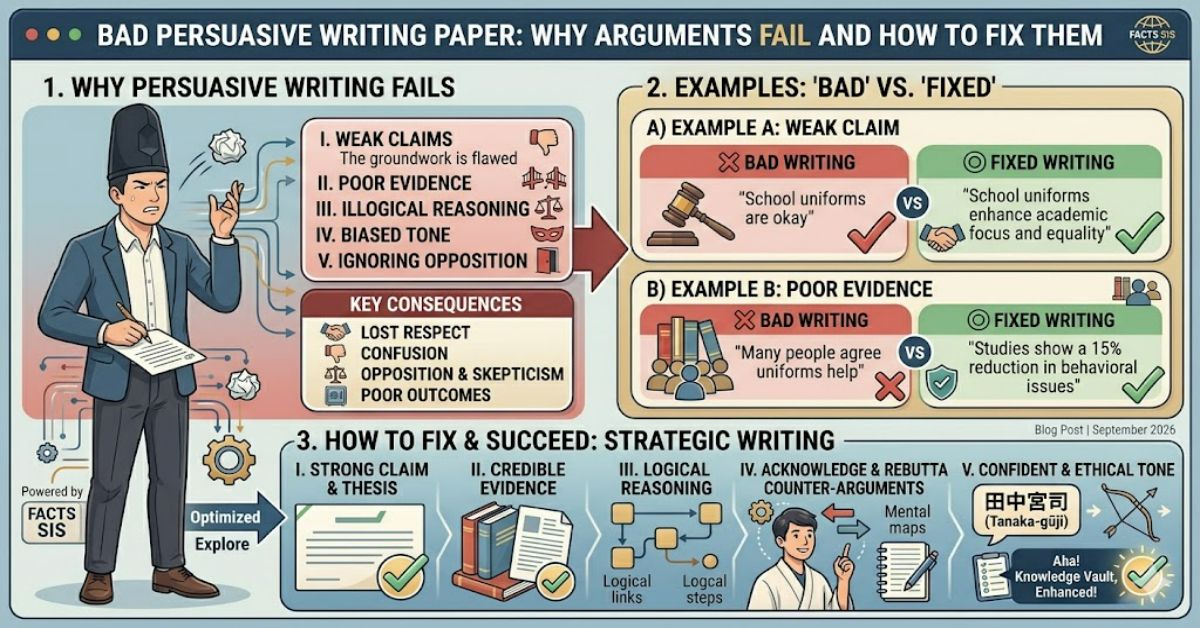
A bad persuasive writing paper does not fail simply because it contains spelling mistakes or awkward sentences. In most cases, it fails because it cannot convince its audience. Persuasive writing is designed to change opinions, influence decisions, or encourage action. When an essay lacks evidence, relies heavily on emotional appeals, ignores counterarguments, or presents a weak thesis, the reader has little reason to accept its conclusions.
Students often assume that strong opinions automatically create persuasive arguments. The reality is quite different. Academic persuasion depends on logical reasoning, credible sources, and a clear structure that guides readers through the argument step by step. Without these elements, even a passionate essay can become ineffective.
Educators frequently identify the same recurring weaknesses in unsuccessful persuasive papers. Unsupported claims, inconsistent organisation, logical fallacies, and poor source selection appear across secondary school, college, and university writing. These issues reduce credibility and make readers question the writer’s authority.
Understanding why persuasive essays fail is valuable not only for students but also for professionals who write reports, proposals, policy recommendations, and opinion pieces. The principles of persuasion apply across many forms of communication.
This article examines the characteristics of ineffective persuasive writing, explores the practical consequences of weak arguments, analyses common mistakes, and explains how writers can strengthen their work through evidence-based techniques.
What Makes a Persuasive Paper Effective?
Before examining failure, it is important to understand success.
An effective persuasive paper contains four essential components:
- A clear thesis statement
- Logical reasoning
- Credible supporting evidence
- Consideration of opposing viewpoints
When these elements work together, readers can follow the argument and evaluate its merits objectively.
The Core Structure of Persuasion
| Element | Purpose | Impact on Readers |
| Thesis Statement | Defines the argument | Establishes direction |
| Evidence | Supports claims | Builds credibility |
| Reasoning | Connects evidence to conclusions | Demonstrates logic |
| Counterarguments | Addresses opposing views | Increases trust |
| Conclusion | Reinforces argument | Encourages acceptance |
A weakness in any one of these areas can significantly reduce the paper’s effectiveness.
Common Signs of a Bad Persuasive Writing Paper
Several warning signs appear consistently in ineffective argumentative essays.
Weak or Unclear Thesis Statements
The thesis serves as the foundation of persuasive writing.
Poor example:
“Social media has both good and bad effects.”
This statement is descriptive rather than persuasive. It offers no position for readers to evaluate.
Stronger example:
“Secondary schools should introduce mandatory social media literacy programmes because digital misinformation significantly affects student decision-making.”
The stronger version presents a clear claim that can be supported with evidence.
Lack of Supporting Evidence
One of the most common problems is reliance on personal opinion.
Consider the statement:
“School uniforms should be banned because students dislike them.”
The argument assumes that dislike alone justifies policy changes. Without surveys, research studies, or expert analysis, readers have no reason to accept the conclusion.
Persuasive writing requires evidence from credible sources such as academic journals, government reports, recognised experts, and reputable research institutions.
Poor Organisation
Arguments become difficult to follow when ideas appear in random order.
Readers should be able to identify:
- The main claim
- Supporting arguments
- Evidence
- Counterarguments
- Final conclusion
When transitions are missing, persuasive power decreases because readers struggle to understand how points connect.
The Role of Logical Fallacies
A major characteristic of a bad persuasive writing paper is the presence of logical fallacies.
Logical fallacies are errors in reasoning that make arguments appear convincing while lacking genuine support.
Common Fallacies Found in Student Essays
| Fallacy | Description | Example |
| Ad Hominem | Attacks a person instead of the argument | “The professor is wrong because he is old.” |
| Straw Man | Misrepresents an opposing view | “People who support recycling want to ban all plastic.” |
| False Dilemma | Presents only two options | “Either support this policy or you don’t care about students.” |
| Hasty Generalisation | Draws broad conclusions from limited evidence | “Two students cheated, so all students cheat.” |
| Appeal to Emotion | Uses feelings instead of evidence | “Think of the children.” |
These fallacies may persuade some readers emotionally, but they rarely withstand critical examination.
Why Evidence Matters More Than Opinion
Many struggling writers confuse passion with persuasion.
Strong feelings can help communicate conviction, but they cannot replace evidence.
Evidence Creates Credibility
Readers evaluate arguments based on trustworthiness.
Evidence can include:
- Academic studies
- Statistical data
- Expert testimony
- Historical examples
- Case studies
When claims are unsupported, readers must rely solely on the writer’s opinion.
Real-World Example
A public health campaign encouraging vaccination is unlikely to succeed if it simply states:
“Vaccines are good.”
However, presenting clinical trial data, safety records, and expert medical consensus creates a stronger argument because readers can evaluate objective information.
The same principle applies to academic essays.
Ignoring Opposing Viewpoints
One of the clearest indicators of weak persuasive writing is the complete absence of counterarguments.
Writers sometimes believe acknowledging opposing views weakens their position.
The opposite is usually true.
Why Counterarguments Strengthen Persuasion
Addressing opposing perspectives demonstrates:
- Intellectual honesty
- Critical thinking
- Subject knowledge
- Confidence in the argument
For example, an essay advocating remote work should acknowledge concerns regarding collaboration and communication before explaining why benefits outweigh limitations.
When opposing views are ignored entirely, readers may perceive the argument as one-sided.
Strategic Implications of Poor Persuasive Writing
Weak persuasion has consequences beyond academic grades.
Educational Impact
Students who struggle with persuasive writing often experience difficulties in:
- Research assignments
- Scholarship applications
- University admissions essays
- Professional communication
Professional Impact
Business proposals, grant applications, and policy recommendations all rely on persuasive communication.
Poor argumentation can result in:
- Lost funding opportunities
- Failed proposals
- Reduced organisational influence
- Lower stakeholder confidence
Communication skills increasingly affect career advancement across industries.
Hidden Problems Often Overlooked
Many discussions focus on obvious weaknesses such as grammar or evidence. However, several less-discussed issues deserve attention.
Insight 1: Excessive Emotional Language Creates Distrust
Research in communication studies suggests readers become sceptical when arguments rely heavily on emotional intensity without supporting evidence.
Writers who attempt to persuade through outrage alone often undermine credibility.
Insight 2: Source Quantity Does Not Equal Source Quality
Some students believe adding numerous citations automatically strengthens an essay.
Poor-quality sources can actually weaken an argument.
Five peer-reviewed studies generally provide more persuasive support than twenty unreliable websites.
Insight 3: Audience Mismatch Reduces Persuasion
Many essays fail because writers do not consider audience expectations.
An argument designed for academics differs significantly from one aimed at policymakers or the general public.
Understanding audience needs often matters as much as evidence itself.
Structured Analysis of Persuasive Writing Failures
| Failure Point | Short-Term Effect | Long-Term Consequence |
| Weak Thesis | Reader confusion | Reduced persuasiveness |
| Lack of Evidence | Credibility loss | Argument rejection |
| Logical Fallacies | Trust erosion | Academic criticism |
| Poor Organisation | Reading difficulty | Lower engagement |
| No Counterarguments | Perceived bias | Reduced authority |
| Weak Sources | Reliability concerns | Argument collapse |
How to Transform a Weak Persuasive Essay
Improvement begins with systematic revision.
Step 1: Strengthen the Thesis
Ensure the thesis:
- Takes a clear position
- Is debatable
- Can be supported with evidence
Step 2: Audit Every Claim
For each major point, ask:
“What evidence supports this statement?”
Unsupported claims should either be removed or strengthened.
Step 3: Identify Logical Fallacies
Review arguments for reasoning errors.
Writers often discover fallacies during peer review or self-editing.
Step 4: Add Counterarguments
Address at least one significant opposing viewpoint and explain why the primary argument remains stronger.
Step 5: Improve Organisation
Arrange ideas logically:
- Introduction
- Thesis
- Supporting argument
- Evidence
- Counterargument
- Rebuttal
- Conclusion
The Future of Persuasive Writing Assessment in 2027
Persuasive writing will likely face new challenges by 2027 due to the growing influence of artificial intelligence tools, automated content generation, and digital misinformation.
Educational institutions are increasingly emphasising critical thinking rather than simple essay production. Assessment methods are expected to focus more heavily on reasoning quality, source evaluation, and argument construction.
AI-assisted writing may help students organise ideas, but educators are already developing frameworks that evaluate analytical depth and originality rather than surface-level fluency.
Another trend involves greater emphasis on media literacy. As misinformation becomes more sophisticated, persuasive writing instruction will likely prioritise evidence verification, source credibility assessment, and logical reasoning.
The core principles of effective persuasion—evidence, logic, and audience awareness—are unlikely to change, even as writing technologies continue to evolve.
Key Takeaways
- Strong persuasive writing depends on evidence rather than opinion.
- Logical fallacies remain one of the most common causes of argument failure.
- Counterarguments often strengthen credibility rather than weaken it.
- Audience awareness significantly influences persuasive success.
- Organisation determines how effectively readers process arguments.
- Source quality matters more than citation quantity.
- Future writing assessment will increasingly prioritise critical thinking skills.
Conclusion
A bad persuasive writing paper rarely results from a single mistake. More often, multiple weaknesses combine to reduce the argument’s effectiveness. A weak thesis, poor organisation, unsupported claims, logical fallacies, and failure to address opposing viewpoints all contribute to persuasive failure.
The strongest persuasive essays share a common characteristic: they respect the reader’s need for evidence and logical reasoning. Rather than demanding agreement, they build a convincing case step by step. This distinction separates effective persuasion from mere opinion.
Whether writing for academic, professional, or public audiences, the same principles apply. Clear arguments, credible evidence, thoughtful organisation, and intellectual honesty remain the foundations of successful persuasion.
Writers who focus on these fundamentals can transform weak essays into compelling arguments capable of influencing readers and achieving their intended purpose.
Frequently Asked Questions
What is the biggest sign of a weak persuasive essay?
The most common indicator is a lack of evidence supporting major claims. Without credible evidence, arguments rely primarily on opinion.
Can emotional appeals be used in persuasive writing?
Yes. Emotional appeals can enhance persuasion when combined with logical reasoning and factual support. Problems arise when emotions replace evidence entirely.
Why do students write ineffective persuasive essays?
Common reasons include weak research, unclear thesis statements, poor organisation, and misunderstanding the audience.
How many sources should a persuasive essay include?
There is no universal number. The focus should be on source quality, relevance, and credibility rather than quantity alone.
Are counterarguments required in persuasive writing?
In most academic contexts, yes. Addressing opposing viewpoints demonstrates critical thinking and strengthens credibility.
How can I improve a bad persuasive writing paper quickly?
Review the thesis, add stronger evidence, remove logical fallacies, improve structure, and address counterarguments.
Methodology
This article was developed using established principles from rhetoric, composition studies, argumentation theory, and academic writing instruction. The analysis draws upon educational frameworks commonly used in secondary and higher education writing programmes.
The article evaluates Bad Persuasive Writing Paper through evidence-based criteria including thesis quality, source credibility, logical reasoning, audience awareness, and structural organisation.
Limitations include variations in institutional writing standards and disciplinary expectations. Different educational contexts may prioritise certain persuasive techniques differently.
Counterarguments were considered throughout the analysis, particularly regarding the role of emotional appeals and audience adaptation, to ensure a balanced assessment.
Editorial Disclosure
This article was drafted with AI assistance and reviewed and verified by [Author Name]. All data, citations, and claims should be independently confirmed by the editorial team before publication.