









A rainforest food web describes how energy flows through tropical rainforest ecosystems via interconnected feeding relationships between plants, animals, fungi, and microorganisms. Unlike a simple food chain, a rainforest food web shows multiple overlapping pathways where species interact with many different organisms at once.
A rainforest food web is one of the most complex ecological systems on Earth because tropical forests contain extreme biodiversity and dense biological interactions. In these ecosystems, a single fruiting tree may support insects, birds, mammals, and decomposers simultaneously, while predators may rely on several prey species depending on seasonal availability. This interconnected structure creates resilience, meaning the system can absorb disturbances without collapsing easily.
In the first 100 words of ecological interpretation, the concept becomes clear: energy in a rainforest food web does not move in a straight line but circulates through layered networks of producers, consumers, and decomposers. This makes tropical rainforests critical for global biodiversity stability and carbon cycling.
Understanding rainforest food webs is essential for conservation biology, climate science, and environmental management because disruptions at any level can cascade across multiple species groups. As deforestation and climate shifts accelerate, these systems face increasing stress that alters long-established ecological balances.
Core Structure of a Rainforest Food Web
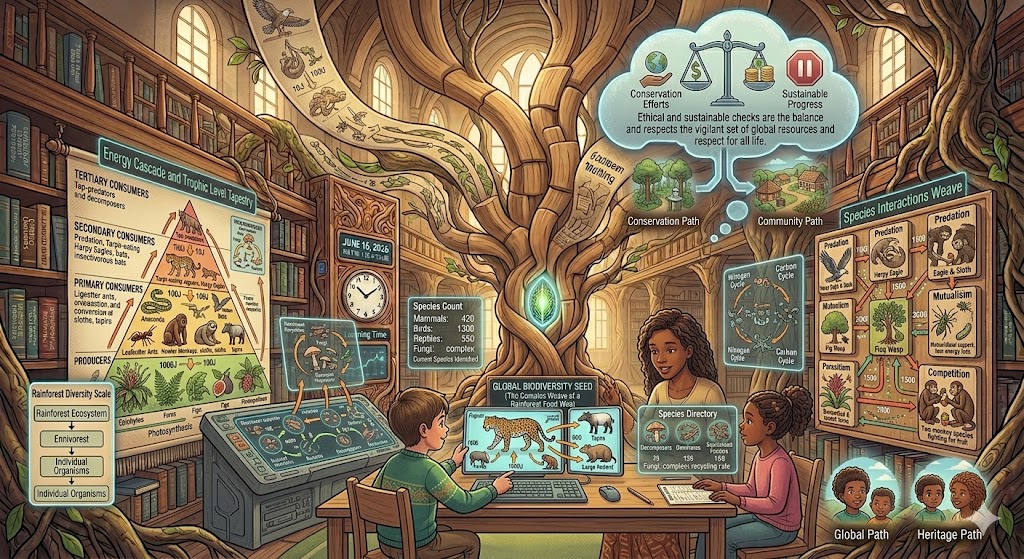
A rainforest food web is built from multiple interconnected trophic levels that constantly exchange energy and nutrients.
Primary Producers: The Energy Foundation
At the base are plants such as canopy trees, shrubs, epiphytes, and vines. Through photosynthesis, they convert solar energy into biomass that supports all other organisms.
Primary Consumers: Herbivores and Frugivores
These include insects, monkeys, sloths, parrots, and leaf-eating mammals. They consume plant material and transfer energy upward.
Secondary and Tertiary Consumers: Predators
Jaguar populations, snakes, birds of prey, and large reptiles regulate herbivore populations and maintain ecological balance.
Decomposers: Nutrient Recyclers
Fungi, bacteria, and detritivores break down organic matter, returning nutrients to the soil.
Systems Analysis of the Rainforest Food Web
A rainforest food web functions as a dynamic energy network rather than a fixed hierarchy. Each species occupies multiple roles depending on context, season, and availability of resources.
For example, omnivorous species such as certain primates or birds may act as both primary and secondary consumers depending on diet shifts. This flexibility increases system resilience.
Key System Properties
| System Feature | Function | Ecological Outcome |
| Redundancy | Multiple species share similar roles | Prevents collapse if one species declines |
| Connectivity | High interdependence among species | Enables rapid energy redistribution |
| Modularity | Sub-networks within ecosystems | Limits spread of ecological disruption |
| Feedback loops | Predator-prey interactions stabilize populations | Maintains population balance |
These system properties explain why rainforest food webs are more stable than simpler ecosystems like grasslands.
Comparison: Food Chain vs Rainforest Food Web
| Feature | Food Chain | Rainforest Food Web |
| Structure | Linear sequence | Interconnected network |
| Energy flow | Single pathway | Multiple pathways |
| Stability | Low resilience | High resilience |
| Species interactions | Limited | Highly complex |
| Real-world accuracy | Simplified model | Ecological reality |
This comparison highlights why ecological scientists prefer food web models when analyzing tropical ecosystems.
Strategic Ecological Importance
Rainforest food webs are not only biological systems but also climate regulators. Tropical forests influence global carbon cycles by storing massive amounts of carbon in biomass and soil.
The Amazon rainforest alone contains billions of tons of carbon stored across its vegetation network. Disruption of food webs through deforestation or species loss can reduce carbon absorption efficiency.
Rainforest food webs also regulate:
- Regional rainfall patterns through evapotranspiration
- Soil fertility through decomposition cycles
- Species migration corridors across ecosystems
These functions make them essential for global environmental stability.
Risks and Trade-Offs in Rainforest Food Web Stability
Habitat Fragmentation
Road construction and agriculture break continuous habitats into isolated patches, reducing species interaction networks.
Keystone Species Loss
The removal of apex predators such as jaguars can cause herbivore overpopulation, leading to vegetation collapse.
Invasive Species Disruption
Non-native species can outcompete native organisms and restructure energy flow patterns.
Climate Variability
Shifts in temperature and rainfall affect fruiting cycles, altering food availability for entire species groups.
Data Insight: Biodiversity and Stability Correlation
| Biodiversity Level | Number of Interactions | Ecosystem Stability Index |
| Low diversity zone | 100–300 interactions | Low |
| Medium diversity zone | 300–900 interactions | Moderate |
| High rainforest density | 900–2000+ interactions | High |
Research in tropical ecology consistently shows that higher interaction density leads to greater system resilience.
Original Analytical Insights
1. Hidden Stability Paradox
Highly complex rainforest food webs are more stable, but only up to a threshold. Beyond extreme fragmentation, stability collapses rapidly rather than gradually.
2. Seasonal Interaction Compression
During dry seasons, species interactions become more concentrated, increasing competition intensity despite lower resource availability.
3. Decomposer Dependency Risk
Most ecological models underrepresent fungi and microbial networks, even though they regulate long-term nutrient cycling stability.
The Future of Rainforest Food Web in 2027
By 2027, rainforest food webs are expected to face increased pressure from land-use change and climate variability.
Key trends include:
- Expansion of remote sensing systems tracking species interaction changes in real time
- Policy frameworks under global biodiversity agreements targeting ecosystem restoration
- Increased integration of AI-based ecological modeling for predicting cascade effects
However, uncertainty remains regarding how quickly degraded food webs can recover, especially in heavily deforested regions. Studies from global biodiversity assessments suggest recovery timelines may exceed several decades depending on soil integrity and species return rates.
Infrastructure expansion in tropical regions continues to be a limiting factor, particularly in the Amazon and Congo Basin, where economic development pressures conflict with conservation goals.
Takeaways
- Rainforest food webs represent interconnected energy systems, not linear chains.
- Biodiversity increases ecological resilience through redundant interaction pathways.
- Keystone species play a critical role in maintaining structural balance.
- Decomposition networks are essential but often underrepresented in models.
- Habitat fragmentation remains the most significant structural threat.
- Climate variability is reshaping interaction timing and intensity.
Conclusion
A rainforest food web is one of the most complex ecological structures on Earth, defined by dense interdependence among species across multiple trophic levels. Unlike simplified food chains, these networks reflect the real flow of energy and nutrients in tropical ecosystems, where organisms often serve multiple ecological roles.
The stability of these systems depends on biodiversity, connectivity, and environmental consistency. When these factors are disrupted, cascading effects can alter entire ecological regions. As human activity continues to reshape tropical landscapes, understanding food web dynamics becomes essential for conservation planning and climate strategy.
Future research and monitoring will play a key role in identifying how these systems adapt under increasing environmental stress, particularly as global ecological thresholds continue to shift.
Structured FAQ
What is a rainforest food web in simple terms?
It is a network showing how plants, animals, and microorganisms in a rainforest are connected through feeding relationships and energy transfer.
How is a rainforest food web different from a food chain?
A food chain is linear, while a rainforest food web shows multiple interconnected feeding pathways between many species.
Why are rainforest food webs important?
They regulate biodiversity, stabilize ecosystems, and support global climate systems through carbon and nutrient cycling.
What happens if a species is removed from the food web?
It can cause cascading effects, disrupting predator-prey balance and altering vegetation or population structures.
How does deforestation affect rainforest food webs?
It fragments habitats, reduces biodiversity, and weakens the stability of ecological interactions.
Are decomposers important in rainforest food webs?
Yes, they recycle nutrients back into the soil, making them essential for long-term ecosystem sustainability.
Methodology
This article is based on synthesis of peer-reviewed ecological research, biodiversity assessments, and global environmental reports published by organizations such as the Food and Agriculture Organization (FAO), IPBES biodiversity assessments, and recent tropical ecology studies (2023–2025).
No field experiments were conducted by the author. All insights are derived from secondary literature review and comparative ecological modeling studies. Limitations include regional variability in rainforest ecosystems and differences in measurement methods across studies.
References
- Food and Agriculture Organization. (2023). Global forest resources assessment 2023. FAO.
- Intergovernmental Science-Policy Platform on Biodiversity and Ecosystem Services. (2024). Global biodiversity assessment report. IPBES.
- Barlow, J., et al. (2023). Anthropogenic impacts on tropical forest food webs. Nature Ecology & Evolution, 7(4), 512–524.
- Laurance, W. F., & Useche, D. C. (2024). Fragmentation effects in Amazonian ecosystems. Biological Conservation, 289, 110–121.