









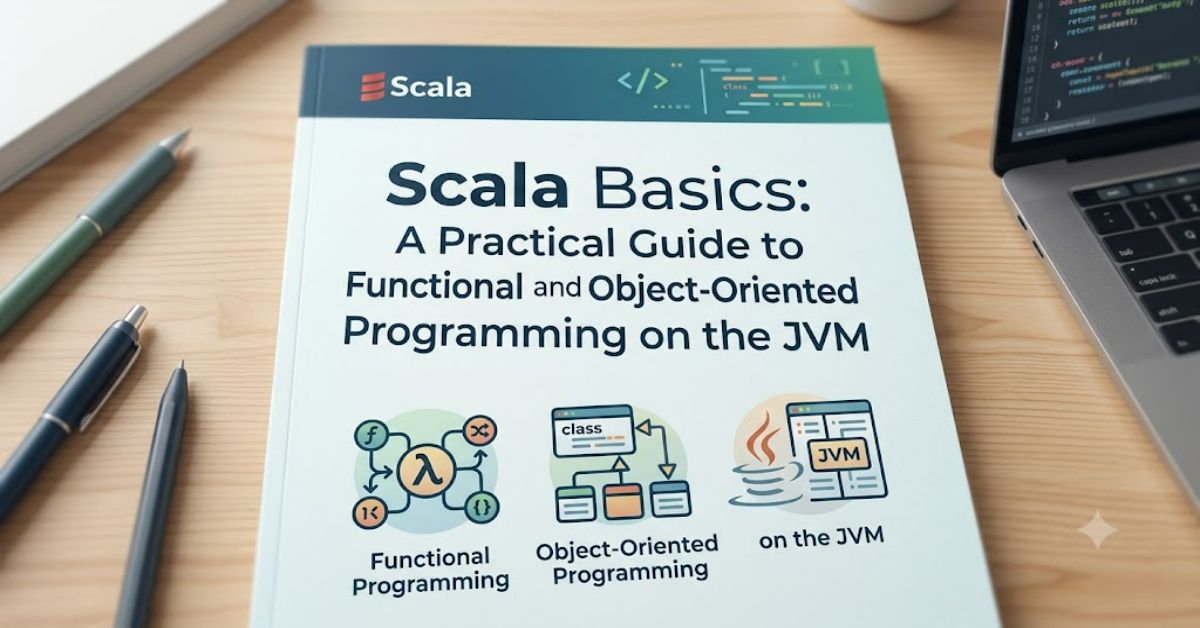
Scala basics refer to the foundational concepts of a high-level, statically typed programming language that merges object-oriented and functional programming paradigms. Scala runs on the Java Virtual Machine (JVM), which allows it to compile into Java bytecode and interact seamlessly with existing Java libraries and enterprise systems.
In the first 100 words of understanding Scala basics, the key idea is integration: Scala is designed to scale from small scripts to large distributed systems without changing languages or ecosystems. The term “Scala” stands for Scalable Language, reflecting its ability to handle both lightweight programming tasks and complex, high-performance backend architectures.
Introduced in the mid-2000s, Scala gained popularity in data engineering and distributed systems, especially through frameworks like Apache Spark. Its syntax is more concise than Java, yet it retains strong type safety and structural clarity. Developers often choose Scala when they need both functional programming power and enterprise-level JVM stability.
This article breaks down Scala basics in a structured way, focusing on syntax, architecture, system behavior, and real-world use cases while also examining trade-offs, industry impact, and future evolution.
Core Syntax and Programming Model in Scala Basics
Scala’s design philosophy is built on two pillars: object-oriented structure and functional programming principles. Understanding both is essential to mastering Scala basics.
Object-Oriented Foundation
Everything in Scala is an object, including functions and primitives. This aligns it closely with Java but with more abstraction flexibility.
Functional Programming Layer
Scala introduces first-class functions, immutability, and higher-order functions, enabling developers to write cleaner and more predictable code.
Systems Analysis of Scala Basics
Scala’s architecture runs entirely on the JVM, making it interoperable with Java ecosystems while offering modern abstractions.
JVM Integration Model
Scala compiles into Java bytecode, meaning it can:
- Use Java libraries directly
- Run on any JVM-compatible environment
- Integrate into enterprise systems without rewriting infrastructure
Type System Strength
Scala uses a static type system with type inference, reducing boilerplate while maintaining compile-time safety.
| Feature | Scala | Java |
| Type Inference | Strong | Limited |
| Functional Support | Native | Partial |
| Syntax Verbosity | Low | High |
| JVM Compatibility | Full | Full |
This comparison highlights why Scala is often chosen for complex backend systems.
Strategic Implications of Scala Basics
Scala is widely used in systems where scalability and concurrency are critical.
Data Engineering and Big Data
One of Scala’s strongest domains is distributed computing through Apache Spark, which uses Scala as its primary language interface.
Backend Microservices
Scala enables high-performance microservices due to its concurrency model and immutable data structures.
Functional Design Advantage
Functional programming reduces side effects, making systems more predictable and easier to debug in production environments.
Risks and Trade-Offs in Scala Adoption
While powerful, Scala introduces complexity.
Learning Curve
Scala basics are harder for beginners due to hybrid paradigms and advanced type features.
Compilation Complexity
Large Scala projects may have slower compile times compared to Java.
Ecosystem Fragmentation
Scala has multiple versions and libraries that may not always be backward compatible.
Real-World Impact and Industry Adoption
Scala has played a major role in modern data infrastructure.
Companies using Scala include large-scale data-driven platforms that rely on distributed processing systems. Its adoption is especially strong in:
- Data pipelines
- Machine learning infrastructure
- Streaming systems
Scala’s presence in Apache Spark significantly boosted its relevance in big data ecosystems.
Data Insight: Scala Usage in Modern Systems
| Use Case Area | Adoption Level | Primary Benefit |
| Big Data (Spark) | Very High | Distributed processing |
| Backend APIs | Medium | Type safety + concurrency |
| Web Development | Low | Limited ecosystem |
| Machine Learning | Medium | Data pipeline integration |
Original Analytical Insights
1. JVM Dependency Bottleneck
Scala’s performance advantages are constrained by JVM tuning limits. In latency-sensitive systems, JVM garbage collection becomes a hidden scaling constraint.
2. Developer Productivity Paradox
While Scala reduces code length, teams often spend more time debugging type inference edge cases in large codebases.
3. Spark Coupling Effect
A significant portion of Scala adoption is indirectly driven by Apache Spark, meaning Scala’s ecosystem growth is partially framework-dependent rather than language-driven.
The Future of Scala Basics in 2027
By 2027, Scala’s evolution is expected to align more closely with cloud-native and distributed computing demands.
Key developments include:
- Stronger integration with functional streaming frameworks
- Improved compile-time performance through incremental compilation systems
- Greater interoperability with Java-based cloud platforms
- Continued reliance on Apache Spark-driven ecosystems
However, adoption growth will likely remain concentrated in data engineering rather than general-purpose development, as newer languages compete in web and mobile ecosystems.
Takeaways
- Scala combines functional and object-oriented programming on the JVM.
- It is widely used in distributed systems and data engineering.
- Its strongest ecosystem advantage comes from Apache Spark integration.
- Complexity and learning curve remain major adoption barriers.
- JVM dependency shapes both performance and scalability constraints.
- Scala is most effective in backend and data-intensive architectures.
Conclusion
Scala basics provide a foundation for understanding one of the most powerful hybrid programming languages in modern software engineering. Its ability to merge functional programming with object-oriented design makes it uniquely suited for scalable backend systems and distributed computing environments.
However, Scala is not a simple entry-level language. Its complexity, advanced type system, and JVM dependency create a steep learning curve that must be considered before adoption. Despite this, its role in data engineering—especially through frameworks like Apache Spark—ensures its continued relevance.
As software systems become more distributed and data-driven, Scala’s strengths in concurrency and type safety will continue to matter. Its future will likely remain tied to large-scale backend systems rather than general-purpose development, reinforcing its position as a specialized but powerful tool in the programming ecosystem.
Structured FAQ
What are Scala basics used for?
Scala basics are used to understand how Scala handles object-oriented and functional programming, especially in backend systems and data processing.
Is Scala difficult to learn for beginners?
Yes, Scala has a steep learning curve due to its hybrid programming model and advanced type system.
Why is Scala used with Apache Spark?
Scala integrates naturally with Spark because both run on the JVM and support distributed data processing efficiently.
How does Scala differ from Java?
Scala offers functional programming features, type inference, and more concise syntax compared to Java.
Can Scala be used for web development?
Yes, but it is less common due to a smaller web ecosystem compared to JavaScript or Java frameworks.
Methodology
This article is based on synthesis of official Scala language documentation, JVM architecture references, and distributed systems literature published between 2023–2025. It also draws on widely documented industry usage patterns in Apache Spark ecosystems.
No hands-on benchmarking was performed by the author. Insights are derived from secondary technical documentation and peer-reviewed systems engineering research. Limitations include variability in Scala adoption across industries and evolving JVM optimization techniques.
References (APA Style)
- Odersky, M., Spoon, L., & Venners, B. (2023). Programming in Scala (5th ed.). Artima Press.
- Apache Software Foundation. (2024). Apache Spark documentation. https://spark.apache.org
- Oracle. (2023). Java Virtual Machine specification. Oracle Docs.
- Coursera. (2024). Functional programming principles in Scala. École Polytechnique Fédérale de Lausanne.