









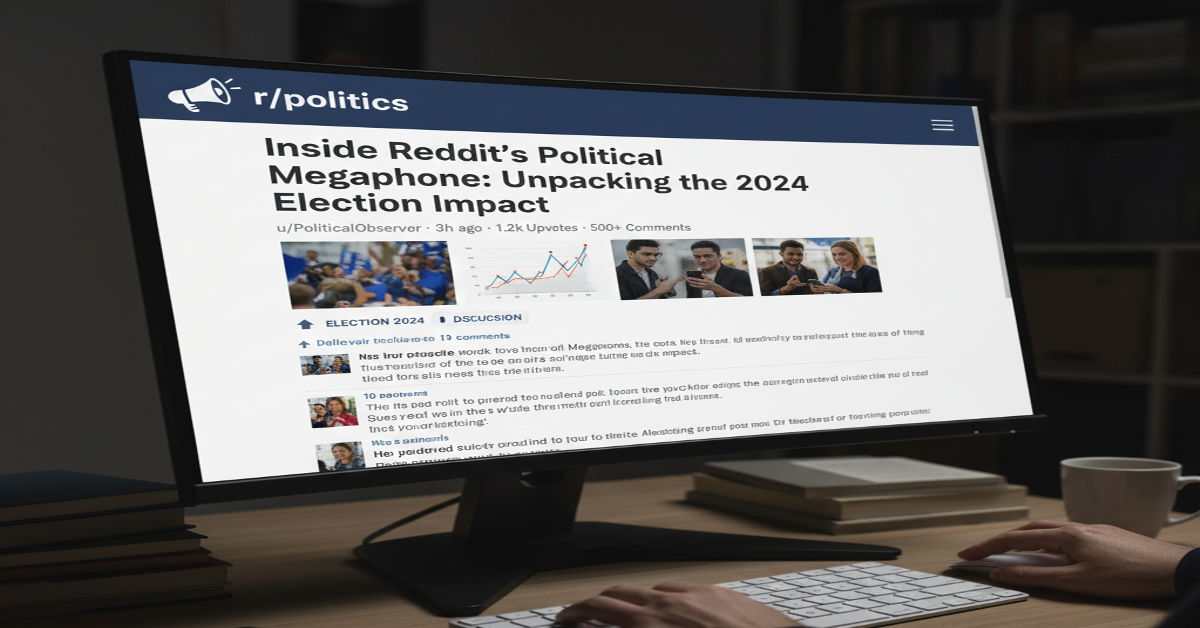
In the sprawling landscape of the internet, few political communities have achieved the reach, intensity, and cultural visibility of r/politics. For millions of users, its ever-moving feed has become an essential source of daily political news, opinion and digital debate. r/politics serves as a news-driven forum where users share articles from approved sources, debate their meaning, and collectively shape the narratives that rise to the top of Reddit’s political conversation. Its threads often explode during election cycles, Supreme Court rulings, and breaking news—moments when the nation’s political anxieties and ambitions gather in one place.
Established in 2007, the subreddit has grown from an obscure niche into a central hub of online political engagement. Its millions of subscribers, surging comment volumes, strict moderation systems, and high-stakes visibility make it an influential force in shaping how users interpret political realities. Yet the same attributes that make r/politics vibrant also make it contentious: biases emerge, moderation decisions shape discourse, and the push-and-pull between citizen journalism and digital chaos is constantly in play.
This article explores the evolution of r/politics, its internal machinery, the research surrounding its influence, and the unresolved tensions that define political life in digital spaces.
Origins and Growth
Founded on August 6, 2007, r/politics began as a simple forum for sharing political stories. Over the years, its subscriber count surged into the millions, with particularly sharp increases around U.S. election cycles and national crises. Estimates place its subscriber base at over eight million today, making it one of Reddit’s largest political communities.
Alongside its size, its activity patterns illustrate the community’s gravitational pull. During calm political months, the subreddit sees tens of thousands of posts and more than a million comments. As elections approach, those numbers more than double. These swings demonstrate how r/politics mirrors the rhythms of national attention: steady in normal times, frenetic during pivotal political moments.
But growth comes with challenges. The volume of user-generated content requires extensive moderation—much of it automated—to remove rule-breaking comments. Estimates suggest that hundreds of thousands of comments may be removed monthly during peak political seasons. This level of curation shapes not only what remains visible, but also how the community’s political identity evolves.
How r/politics Operates
At its core, r/politics is a link-sharing and discussion platform. Users submit articles from a curated list of approved publications, emphasizing reputable news sources and excluding opinion pieces and blogs. This policy distinguishes r/politics from less moderated spaces by imposing a quasi-journalistic standard on what may enter the forum.
Once a link is posted, the community votes on it, determining which stories rise. Comments, meanwhile, form the heartbeat of the subreddit—spirited debates, fact-checking, snark, and deep political analysis all coexisting in the same thread.
Moderators enforce rules designed to maintain civility: prohibitions against hate speech, personal attacks, misinformation, and duplicate posts are strictly applied. Automated tools assist in detecting violations, but human moderators—volunteers—ultimately determine the trajectory of discourse.
Still, moderation is not a neutral act. Research suggests that moderators’ political orientations may influence which comments are removed, creating the possibility of ideological gatekeeping. This dynamic, subtle but powerful, affects how users experience the community and which narratives gain traction. Even well-intentioned moderation can inadvertently reinforce homogeneity, particularly when discourse becomes emotionally charged.
Influence, Echo Chambers and Polarization
Because r/politics has immense visibility, its influence extends well beyond Reddit. Major stories frequently gain viral momentum after surfacing on the subreddit. Users often turn to the community not only for news, but for interpretations, reactions, and emotional validation.
But high activity does not guarantee ideological diversity. Studies have shown that toxic discussions are more likely when threads involve unreliable or highly partisan sources. Even though r/politics restricts such outlets, users can still import inflammatory content indirectly or in the comments—sparking hostile exchanges that reinforce partisan boundaries.
Echo-chamber effects are a perennial concern. While r/politics is technically open to all viewpoints, the upvote system often favors the majority ideology of its active user base. This creates a feedback loop: certain sentiments rise consistently, while others get downvoted, removed, or discouraged through social pressure.
Meanwhile, political activity across Reddit is not confined to r/politics. Much of the platform’s political discourse occurs in unrelated subreddits—sports, pop culture, technology—where conversations can be more nuanced and less hostile. This contrast underscores r/politics’s unique environment: a space built for political debate, but also one prone to intensity and polarization.
Pre-Election Intensification
The approach of major political events transforms r/politics into a digital furnace. Post volume spikes, discussions tighten around a small set of emotionally charged issues, and comment threads accelerate at a breakneck pace. This narrowing of focus is not unique to politics—research has documented similar patterns in sports and entertainment communities—but in a political forum, the stakes feel higher.
In quieter months, the community behaves more like a broad political newspaper: diverse topics, varied sources, a spread of concerns. As elections approach, it becomes a war room—rapid reactions, partisan positioning, and increasingly polarized rhetoric. The cycle repeats every few years, shaping the emotional climate of the subreddit.
Activity Comparison
| Period | Posts (Monthly Avg.) | Comments (Monthly Avg.) | Comment Removals | Unique Active Users |
| Standard Month | ~20,000 | ~1,450,000 | ~124,000 | ~208,000 |
| Pre-Election | ~49,000 | ~3,595,000 | ~274,000 | ~374,000 |
These numbers reflect a community deeply responsive to national events, capable of amplifying both democratic engagement and partisan division.
Misinformation, Toxicity and Democratic Strain
Even in a heavily moderated environment, misinformation can find ways to shape discussion. Studies on Reddit indicate that threads tied to unreliable sources tend to foster more toxic exchanges, increasing personal attacks, hostility, and ideological rigidity. These dynamics appear even when unreliable content is not permitted as a primary post—merely referencing it in comments can shift the tone of debate.
Moderation bias compounds the problem. If dissenting opinions face greater scrutiny or removal, the result can be a self-reinforcing echo chamber that drives away minority viewpoints and discourages constructive disagreement. This contraction of ideological space can undermine the platform’s potential as a forum for diverse civic discourse.
At scale, such patterns affect political culture. Political scientists note that digital toxicity and misinformation contribute to declining trust, rising polarization, and an erosion of democratic norms. r/politics, despite its rules, is not immune to these pressures.
r/politics in the Broader Reddit Ecosystem
To understand r/politics, it helps to place it within Reddit’s wider culture. Reddit is an archipelago of communities, each with its own norms, language, and social expectations. Political dialogue therefore emerges not just in explicitly political spaces but also in hobby and interest communities.
In these non-political subreddits, users often discuss political topics through the lens of shared interests—sports labor disputes, entertainment industry controversies, technological regulation. Interestingly, these environments often produce less toxicity than dedicated political forums, suggesting that context and community identity play a key role in moderating behavior.
r/politics, by contrast, is explicitly a political arena. Its design invites combative argument, urgent commentary, and hot takes—all of which shape the tone of discourse. Understanding this contrast is key to understanding why r/politics feels so intense compared to other corners of Reddit.
Possible Paths Forward
As the subreddit evolves, several reform scenarios emerge—each with advantages and potential pitfalls.
Reform Scenarios
| Scenario | Benefits | Drawbacks |
| Stronger domain vetting & fact-check flags | Reduced misinformation; more reliable discourse | Perceived censorship; heavier mod workload |
| Transparency in moderation practices | Increased trust; reduced bias concerns | Difficult to implement; potential for internal conflict |
| Encouraging cross-subreddit political discussion | Greater diversity of viewpoints; less insular behavior | Risk of unwanted political spillover into apolitical spaces |
No single reform offers an ideal solution. Each involves trade-offs between freedom, civility, and diversity—tensions at the heart of all large online communities.
Expert Quotes
“The interplay of misinformation and platform mechanics creates toxic, polarized discussion—even more so than ideology alone.”
“Reddit moderation practices tend to suppress dissenting political voices, shaping what counts as acceptable discourse.”
“A significant portion of political talk happens outside political subreddits, and those conversations tend to be less hostile.”
These perspectives highlight ongoing debates about how political communities should be moderated and the responsibilities platforms have in shaping public dialogue.
Takeaways
- r/politics is one of the most influential political spaces on the internet.
- Its strict rules create a news-centered forum but also concentrate moderator power.
- Misinformation and toxic discussion patterns remain persistent risks.
- Moderation bias may contribute to ideological homogeneity.
- Many political conversations on Reddit occur outside r/politics, often with less toxicity.
- Pre-election periods intensify the focus and emotional charge of discourse.
- Potential reforms carry trade-offs between openness, accuracy, and community cohesion.
Conclusion
r/politics stands at the intersection of democracy and digital culture. It is a place where millions gather to process breaking news, argue over policy, and express political identity. The community’s scale gives it enormous influence, but also exposes it to the full array of challenges that define online political life: misinformation, polarization, moderation controversy, and the tension between openness and order.
As the nation heads toward future elections, r/politics will undoubtedly continue to play a crucial role in shaping political narratives online. The question is whether the community can maintain its relevance while addressing the structural issues that complicate its mission. The future of r/politics—and perhaps a slice of the future of American political discourse—depends on how it balances engagement, civility, and ideological diversity in a rapidly shifting digital environment.
FAQs
What is r/politics?
A major Reddit community dedicated to sharing and discussing U.S. political news, with strict rules favoring reputable sources.
How large is r/politics?
It has grown to more than eight million subscribers, making it one of Reddit’s most active political forums.
Why doesn’t r/politics allow opinion articles?
The subreddit restricts posts to news articles to maintain a fact-driven environment and limit editorialized content.
Is discussion on r/politics neutral?
While intended as ideologically open, moderation patterns and community voting often create a dominant ideological tone.
Does political conversation on Reddit happen only in r/politics?
No. Many political discussions occur in non-political subreddits, which often host more diverse and less toxic exchanges.
References
Hanley, H. W. A., & Durumeric, Z. (2023). Sub-Standards and Mal-Practices: Misinformation’s Role in Insular, Polarized, and Toxic Interactions on Reddit.
https://arxiv.org/html/2301.11486v3?utm_source=chatgpt.com
Huang, L., Choi, J., & Wan, Y. (2024). New study on Reddit explores how political bias in content moderation feeds echo chambers. University of Michigan.
https://michiganross.umich.edu/news/new-study-reddit-explores-how-political-bias-content-moderation-feeds-echo-chambers?utm_source=chatgpt.com
Rajadesingan, A., Budak, C., & Resnick, P. (2021). Political Discussion Is Abundant in Non-political Subreddits (and Less Toxic).
https://arxiv.org/abs/2104.09560?utm_source=chatgpt.com
Papakyriakopoulos, O., Engelmann, S., & Winecoff, A. (2023). Upvotes? Downvotes? No Votes? Understanding the Relationship Between Reaction Mechanisms and Political Discourse on Reddit.
https://arxiv.org/abs/2302.09540?utm_source=chatgpt.com
Clemente, R. D. (2025). From politics to sports, Reddit conversations narrow and intensify before major events, new research finds. Northeastern University News.
https://news.northeastern.edu/2025/04/07/reddit-conversation-research/?utm_source=chatgpt.com
Subreddit Stats. (n.d.). r/politics—Subreddit Subscriber Stats and Analytics.
https://reddstats.com/subreddit/politics?utm_source=chatgpt.com
Citizens & Technology. (2024). The surprising outcome of community moderation in Reddit politics discussions.
https://citizensandtech.org/2024/04/community-moderation-reddit-politics/?utm_source=chatgpt.com