










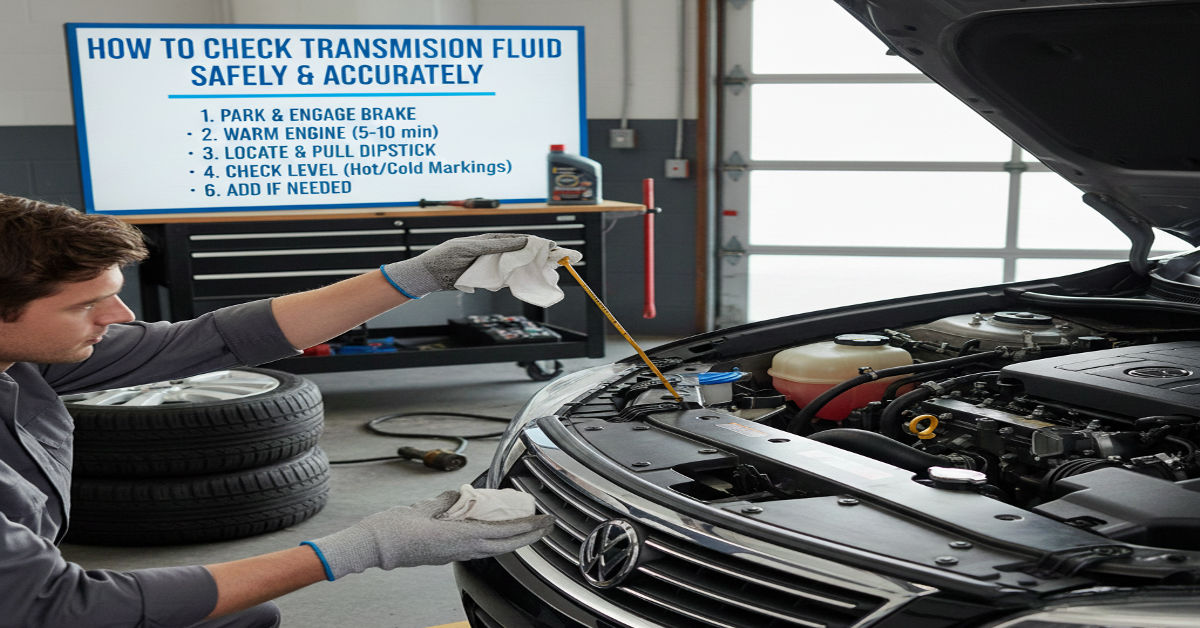
Few car-maintenance tasks are as misunderstood—or as consequential—as checking transmission fluid. For many drivers, the transmission feels mysterious: sealed, technical, and best left to professionals. Yet transmission fluid plays a role as vital as engine oil. It lubricates gears, cools internal components, and allows your car to shift smoothly and predictably. When the fluid level is low or the fluid itself is degraded, the transmission begins to suffer quietly at first, then catastrophically.
For vehicles that allow owner checks, learning how to check transmission fluid is straightforward and empowering. Within minutes, you can spot early warning signs of leaks, overheating or internal wear. The essential answer is simple: checking transmission fluid usually involves warming the car, parking on level ground, locating the dipstick or fill plug, and evaluating both the fluid level and its condition. Healthy fluid is clean, appropriately colored, and within the specified range.
Modern vehicles complicate the picture with sealed transmissions and manufacturer-specific procedures, but the fundamentals remain the same. Understanding what transmission fluid does, how it behaves, and what it should look like gives drivers agency over one of the most expensive systems in their car. This article explains the process in depth—without shortcuts, scare tactics, or jargon—so you can approach transmission maintenance with clarity and confidence.
What Transmission Fluid Does—and Why It Matters
Transmission fluid is more than a lubricant. In automatic transmissions, it functions as a hydraulic fluid that enables gear changes, transfers power through the torque converter, and regulates internal pressures. In both automatic and manual systems, it also dissipates heat generated by friction. Without sufficient or healthy fluid, metal components grind against one another, temperatures spike, and seals begin to fail.
Because transmission repairs are among the most expensive in automotive service, fluid condition is a critical early indicator. Clean fluid cushions components and preserves tolerances; degraded fluid accelerates wear. Unlike engine oil, transmission fluid is not always burned or consumed. When levels drop, it often signals a leak. When fluid darkens or smells burnt, it usually indicates overheating or internal friction.
Many drivers mistakenly assume that if a car shifts, the transmission must be healthy. In reality, damage accumulates long before symptoms become obvious. Routine fluid checks serve as a diagnostic window—revealing problems early, when solutions are simpler and far less costly.
Automatic vs. Manual Transmissions: Key Differences
The method for checking transmission fluid depends primarily on whether the vehicle has an automatic or manual transmission.
Automatic transmissions traditionally include a dipstick, similar to an engine oil dipstick, located in the engine bay. This allows drivers to check fluid level and condition without lifting the vehicle. However, many newer automatics are “sealed,” meaning they lack a dipstick and require specialized procedures or tools.
Manual transmissions rarely have dipsticks. Instead, they use a fill or check plug on the transmission housing. Checking fluid in these systems typically requires raising the vehicle safely and removing the plug to confirm that fluid sits at the correct height.
These differences matter because applying the wrong procedure can lead to inaccurate readings—or damage. Understanding your transmission type is the first step before attempting any check.
How to Check Automatic Transmission Fluid
For vehicles equipped with a transmission dipstick, the process is methodical but manageable. Accuracy depends on following each step carefully.
Preparing the Vehicle
Start by driving the car for five to ten minutes. Transmission fluid expands as it warms, and most manufacturers specify that checks be performed at operating temperature. Park on a level surface and engage the parking brake. Leave the engine running unless your owner’s manual states otherwise.
Open the hood and locate the transmission dipstick. It is usually marked with a bright handle and positioned toward the rear of the engine bay. If you are unsure, consult the owner’s manual rather than guessing.
Checking Level and Condition
Pull the dipstick out and wipe it clean with a lint-free cloth. Reinsert it fully, then remove it again to read the level. The fluid should fall between the “Add” and “Full” markings. Some dipsticks include hot and cold indicators—use the one appropriate to your check conditions.
Observe the fluid’s appearance. Healthy automatic transmission fluid is typically bright red or pink and translucent. Dark brown fluid, black fluid, or fluid with a burnt odor suggests deterioration and the need for service.
Adding Fluid Safely
If the level is low, add the manufacturer-specified fluid using a funnel. Add small amounts, checking frequently. Overfilling is as harmful as underfilling, leading to foaming and erratic hydraulic pressures.
Checking Fluid in Manual Transmissions
Manual transmission fluid checks are less common for owners because they require access beneath the vehicle. Still, the principles are straightforward.
Park on a level surface and secure the vehicle. Use a jack and jack stands rated for your car’s weight—never rely on a jack alone. Locate the fill plug on the side of the transmission housing, usually about halfway up.
With the vehicle level, remove the plug carefully. If fluid drips out slightly, the level is correct. If no fluid emerges, add the appropriate fluid until it reaches the bottom edge of the opening. Replace the plug securely before lowering the vehicle.
Because manual transmissions use different fluid formulations, always follow manufacturer specifications precisely.
Temperature, Gear Position and Accuracy
Transmission fluid checks are sensitive to conditions. Temperature is the most critical variable. Fluid expands significantly when warm, which is why many checks specify a hot engine. Checking cold fluid when a hot check is required can make levels appear falsely low.
Some procedures also require cycling through all gear positions before checking. This circulates fluid through the valve body and torque converter, ensuring an accurate reading. Always consult the vehicle’s documentation to confirm whether this step is necessary.
Equally important is surface level. Even a slight incline can skew readings by causing fluid to pool unevenly inside the transmission. A truly level surface is essential for reliable results.
Common Mistakes Drivers Make
One of the most frequent mistakes is using the wrong fluid type. Transmission fluids are engineered with specific friction properties, additives, and viscosities. Using the incorrect fluid can cause slipping, harsh shifts, or long-term damage.
Another common error is assuming “sealed” transmissions never require attention. While some are designed for extended intervals, none are immune to leaks, overheating, or contamination.
Finally, many drivers ignore fluid condition and focus only on level. Color, clarity, and smell often tell a more important story than the dipstick marking alone.
Transmission Fluid Condition at a Glance
| Fluid Appearance | What It Suggests | Recommended Action |
| Bright red, clear | Normal condition | No action needed |
| Dark red/brown | Aging fluid | Schedule service |
| Black, burnt odor | Overheating | Immediate inspection |
| Milky or cloudy | Contamination | Professional diagnosis |
| Metallic particles | Internal wear | Urgent evaluation |
Expert Perspectives on Transmission Care
“Transmission fluid isn’t just lubrication—it’s the medium that allows the transmission to function at all.”
“Most catastrophic transmission failures are preceded by fluid issues that could have been caught early.”
“Drivers should never assume that long service intervals mean zero maintenance.”
These perspectives reflect a consensus across automotive engineering and repair fields: fluid checks are not optional extras but fundamental maintenance practices.
Automatic vs. Manual: Quick Comparison
| Feature | Automatic | Manual |
| Owner-accessible check | Often yes | Rare |
| Tools required | Rag, funnel | Jack, wrench |
| Check temperature | Usually warm | Usually cool |
| Fluid color | Red/pink | Amber/brown |
| Difficulty | Low | Moderate |
Takeaways
- Transmission fluid enables lubrication, cooling, and shifting.
- Low or degraded fluid causes gradual but serious damage.
- Automatic transmissions may use dipsticks or sealed systems.
- Manual transmissions rely on fill plugs for level checks.
- Fluid color and smell are critical diagnostic clues.
- Overfilling is as dangerous as underfilling.
- Owner’s manuals override general advice.
Conclusion
Checking transmission fluid is one of the most effective preventive maintenance steps a driver can take. It requires attention to detail, patience, and respect for manufacturer guidelines—but not advanced mechanical skill. In a time when vehicles feel increasingly complex, this simple check reconnects drivers with the fundamentals of how their cars work.
Whether you perform the check yourself or use this knowledge to communicate more effectively with a technician, understanding transmission fluid empowers better decisions. It transforms the transmission from a mysterious black box into a system you can monitor and protect. Regular checks do not just extend the life of a component; they preserve reliability, safety, and peace of mind.
FAQs
How often should transmission fluid be checked?
Monthly checks are reasonable for vehicles that allow it, especially under heavy use or stop-and-go driving.
What if my car has a sealed transmission?
Sealed systems still require monitoring and service, but checks are typically performed by professionals using specific procedures.
Is dark fluid always bad?
Darkening indicates aging, but burnt smell or debris signals more serious problems.
Can I mix transmission fluid types?
No. Always use the exact fluid specified by the manufacturer.
Does manual transmission fluid last forever?
No. It degrades over time and should be checked and replaced according to service schedules.
REFERENCES
Edmunds. (2024, June 21). How to check transmission fluid: A step-by-step guide. Retrieved from https://www.edmunds.com/car-maintenance/how-to-check-transmission-fluid.html Edmunds
AutoZone. (n.d.). How to check your transmission fluid. Retrieved from https://www.autozone.com/diy/fluids-chemicals/how-to-check-your-transmission-fluid AutoZone.com
Castrol. (n.d.). Check transmission fluid. Retrieved from https://www.castrol.com/en_pk/pakistan/home/learn/car-maintenance/check-transmission-fluid.html Home
Blackcircles.com. (n.d.). How to check transmission fluid. Retrieved from https://www.blackcircles.com/news/how-to-check-transmission-fluid Blackcircles
Howacarworks.com. (n.d.). How to check and change automatic transmission fluid. Retrieved from https://www.howacarworks.com/transmission/how-to-check-and-change-automatic-transmission-fluid howacarworks.com
Tepte.com. (n.d.). How to check automatic transmission fluid level? Retrieved from https://www.tepte.com/8199/how-to-check-automatic-transmission-fluid-level
