







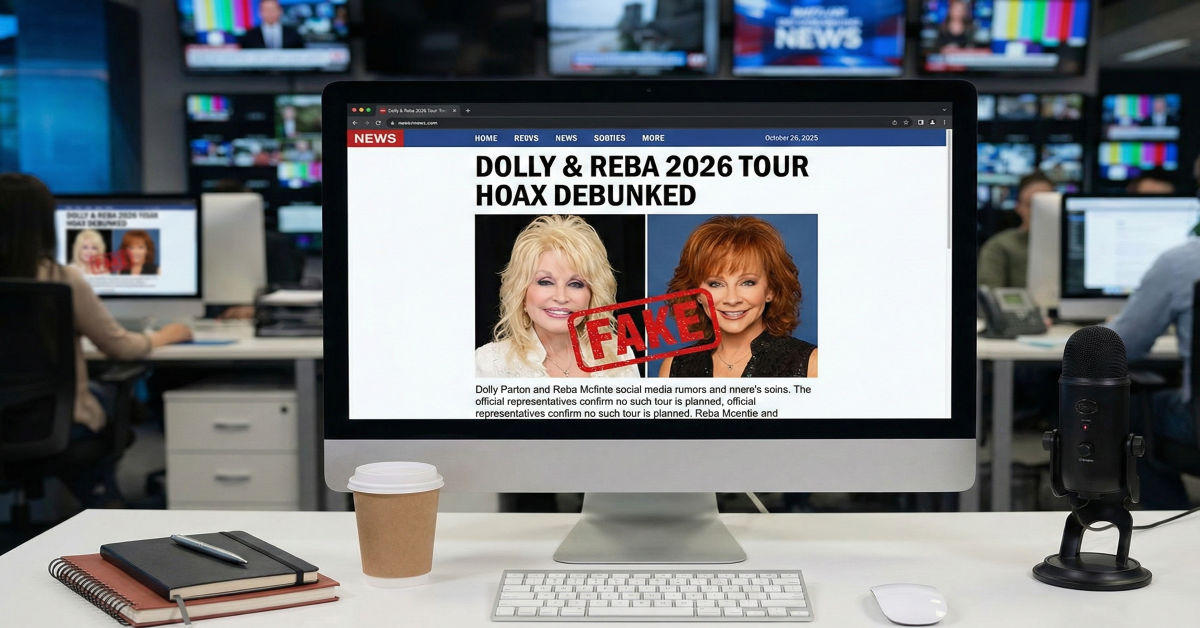
The rumor of a “Dolly and Reba Tour 2026” ignited social media with astonishing speed, leading many fans to believe that two of country music’s most enduring icons were finally joining forces for a national tour. Within the first hundred words of the viral post, excitement surged — but the announcement turned out to be nothing more than a digitally altered illusion. The poster, which appeared polished and convincingly formatted like a legitimate concert campaign, was quickly exposed as AI-generated. Yet for several days, it dominated fan groups, comment threads, and speculative discussions, illustrating how easily desire can overshadow verification.
This article explores how the hoax emerged, why it resonated, what Dolly Parton and Reba McEntire are actually doing in 2026 and what the incident reveals about misinformation in an era when AI-generated imagery circulates faster than official announcements. The story is not simply about a fake tour it’s about the emotional expectations tied to two beloved artists who have collaborated before, shared mutual admiration, and inspired generations of fans. In separating truth from myth, the article aims to give readers a grounded understanding of the dynamics behind the false announcement — and a clearer view of what the real year ahead looks like for both stars.
The Rise of the Fake Tour Announcement
The supposed “Dolly & Reba Tour 2026” began with a single glossy image circulating across major social platforms. The poster seemed credible: high-contrast lighting, stylized typography, and both artists pictured side by side as though they had just completed an official promotional shoot. For those longing to see the pair collaborate onstage, the image carried the emotional weight of a long-awaited dream finally realized.
But red flags were visible from the outset. There were no press releases from management teams, no venue announcements, no ticketing plans, and no posts from either artist’s verified accounts. Fans hoping for confirmation searched in vain for tour dates, presale links, or promoter statements. The absence of basic promotional infrastructure — the lifeblood of any major tour — made the poster’s legitimacy increasingly suspect.
Closer scrutiny revealed telltale signs of AI generation: slight distortions around facial contours, inconsistencies in lighting, and background blurring typical of image-synthesis models. Yet these details went unnoticed at first as engagement skyrocketed. Emotion, more than evidence, drove the spread. Within hours, the rumor had become a self-sustaining loop of excitement, speculation, and wishful thinking.
Dolly Parton’s Real 2026 Plans
While Dolly Parton was not planning a joint tour with Reba, she did have confirmed, documented plans for 2026 — just not the kind being circulated online. After postponing her Las Vegas residency due to health challenges and the need for medical procedures, she rescheduled the engagement for September 2026.
This residency marks a significant milestone: Dolly’s first multi-show Las Vegas commitment in decades. Fans have anticipated the production value, the setlist, and the intimate energy of seeing her perform in a premier venue known for showcasing legacy artists. Throughout the misinformation wave, Dolly remained focused on her existing commitments, making no mention of a tour with Reba and offering no hint of additional large-scale concerts beyond the residency.
The gap between Dolly’s real plans and the fictional tour highlighted how plausible narratives can sprout from thin air when they align with public hopes. Her ongoing relevance, recent health updates, and high-profile return to the stage created fertile ground for rumors — even when unfounded.
Reba McEntire’s Response and Public Perception
Reba McEntire was equally uninvolved in the supposed 2026 tour. When the false poster spiraled into a widespread claim, she dismissed the rumor, expressing support for Dolly and frustration at the misleading image. Her response emphasized the challenges artists face when digital tools can fabricate entire campaigns without their knowledge or consent.
Fans who had initially embraced the poster reacted with a mixture of disappointment and self-reflection. Many acknowledged the power of visual persuasion; others lamented the speed at which misinformation can overshadow factual updates posted by the artists themselves. Reba’s straightforward rejection helped clarify the situation, but by the time she spoke out, the image had already taken on a life of its own.
Her stance reinforced an important point: major tours involve extensive coordination, marketing, rehearsal planning, and venue negotiation. No such groundwork existed. The rumor thrived not because it was plausible, but because fans deeply wanted it to be true.
Why the Hoax Spread: Emotional Mechanics of Misinformation
The rapid growth of the fake announcement spoke volumes about how digital misinformation travels — especially when it taps into nostalgia and long-held fan desires. Several psychological and structural factors played a role:
Emotional resonance.
A joint tour between Dolly and Reba is not a far-fetched concept; their actual 2021 duet revived hope of continued collaboration. Emotional history made the rumor feel believable.
Visual authority.
A well-designed image, even when flawed, carries a veneer of authenticity. Many users treat visuals as proof, especially in the first seconds of an online interaction.
Algorithmic amplification.
Social platforms reward engagement. As users shared the poster with comments like “I can’t believe this!” and “Take my money,” algorithms interpreted the excitement as value, pushing the image further.
Silence from official channels.
In the absence of immediate clarification, doubt and imagination filled the void. Silence was interpreted as possibility, not disproof.
These dynamics created a near-perfect environment for misinformation to flourish, showing how deeply digital communities can influence collective perception.
Factors Influencing the Hoax’s Spread
| Influence Type | Description |
| Emotional Expectation | Fans had long hoped for a Dolly–Reba collaboration, making the image feel plausible. |
| Visual Credibility | The poster resembled authentic promotional materials typical of major tours. |
| Platform Algorithms | High engagement fed rapid circulation and heightened visibility. |
| Lack of Verification | No immediate statements led many users to assume validity before checking sources. |
The Real Artistic Relationship Between Dolly and Reba
It’s important to distinguish false rumors from genuine collaboration. Dolly Parton and Reba McEntire have enjoyed a longstanding, mutual admiration built on shared history within country music. Their 2021 recording of “Does He Love You,” a reinterpretation of Reba’s 1993 hit, demonstrated how effortlessly their voices blend and how naturally their artistic sensibilities merge.
Both artists have spoken publicly about their respect for one another. Dolly described the duet as something she’d “always wanted” to do, while Reba called the experience meaningful and overdue. These sentiments fueled fan enthusiasm, but they also inadvertently primed audiences to accept false announcements.
The hoax gained traction because it seemed like the logical next step in a real creative relationship — proof that falsehoods are most effective when layered upon truths.
Dolly and Reba — Key Milestones
| Year | Collaboration or Event |
| 1993 | Reba releases the original “Does He Love You.” |
| 2021 | Dolly and Reba record the duet together; music video released. |
| 2025 | False AI-generated tour poster circulates online. |
| 2026 | Dolly prepares for her rescheduled Las Vegas residency; Reba confirms no involvement in a joint tour. |
Expert Observations on Digital Culture and Misinformation
Several analysts observing the online rumor cycle have offered insights into why this incident unfolded so quickly and convincingly:
Media scholars note that fandoms often operate on emotional logic rather than strict evidentiary standards. When a claim aligns with collective hopes, skepticism lowers, and trust increases.
Marketing strategists point out that genuine tours of this scale require visible infrastructure: presales, promoter partnerships, venue announcements, and official statements. The absence of these elements is a key indicator that the poster was false.
Digital culture researchers emphasize that AI-generated visuals can bypass critical thinking by appealing directly to the senses. Viewers respond emotionally before intellectually, making falsehoods appear truthful.
Together, these perspectives reveal a cultural moment in which digital illusions can overshadow reality, especially when they involve beloved public figures.
What Fans Can Expect in 2026
For those hoping to see Dolly and Reba together, the hoax was a disappointment — but 2026 still offers meaningful opportunities to enjoy their artistry. Dolly’s Las Vegas residency promises intimate performances, refined staging, and the return of a country legend to a venue that thrives on spectacle. Fans can anticipate a celebratory, career-spanning show that reflects her decades-long legacy.
Reba McEntire has not announced major touring plans for 2026, but she remains active in music, television, and public appearances. The absence of a joint tour does not preclude future artistic intersections; their 2021 duet remains a testament to the chemistry and warmth that define their relationship.
For now, the most accurate way to follow updates is through verified artist channels, official press releases, and legitimate promoters — not viral imagery or speculative fan posts.
Takeaways
- The “Dolly & Reba Tour 2026” was entirely fabricated from an AI-generated image.
- Dolly Parton’s only confirmed 2026 performances are her Las Vegas residency shows.
- Reba McEntire publicly dismissed the rumor and expressed support for Dolly.
- Emotional investment and convincing visuals allowed misinformation to spread rapidly.
- Genuine collaboration exists between the singers, but no joint tour is planned.
- Official sources remain the best resource for tour confirmation.
Conclusion
The imagined “Dolly and Reba Tour 2026” is a reminder of how swiftly misinformation can travel and how powerfully AI-generated media can shape public perception. Yet beneath the digital confusion lies a deeper truth: fans long for moments when beloved artists join forces, and such hopes can overshadow skepticism in an instant.
The real story of 2026 is quieter but no less meaningful. Dolly Parton’s return to the stage in Las Vegas marks another chapter in her storied career, while Reba McEntire’s candid response demonstrates integrity and care for her audience. Their mutual respect endures independent of rumors — and should the two ever choose to embark on a real joint project, it will be announced clearly, officially, and unmistakably.
In the meantime, the episode serves as a cultural case study in how quickly fact and fiction can blur, and how essential it remains to approach viral content with both enthusiasm and discernment.
FAQs
Is there a Dolly and Reba tour in 2026?
No. The rumored tour was based on an AI-generated image and has been confirmed false.
What is Dolly Parton actually doing in 2026?
Dolly is scheduled to perform a multi-show Las Vegas residency in September 2026.
Did Reba McEntire confirm the rumor?
No. Reba dismissed the rumor and expressed support for Dolly while criticizing the misleading image.
Why did the hoax spread?
It aligned with fans’ hopes, used convincing visuals, and spread quickly through social-media algorithms.
Have Dolly and Reba collaborated before?
Yes. Their most notable collaboration is their 2021 duet of “Does He Love You.”