







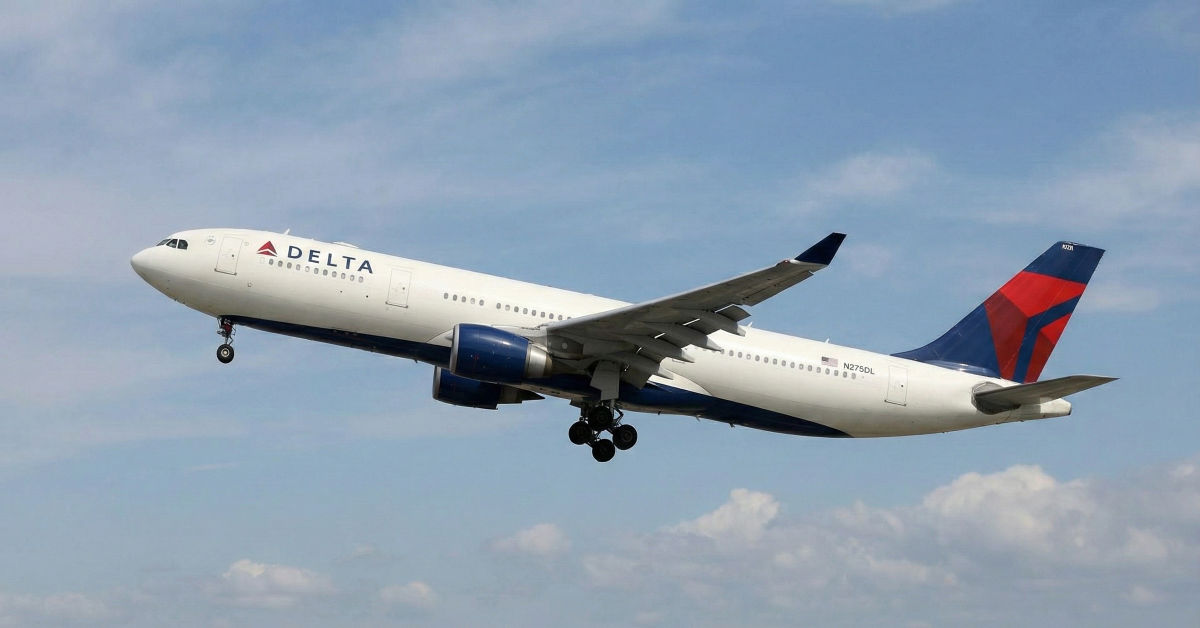
On May 28, 2025 Delta Air Lines flight DL275, en route from Detroit Metropolitan Wayne County Airport (DTW) to Tokyo Haneda Airport (HND), was diverted mid-flight to Los Angeles International Airport (LAX) after the flight crew detected a malfunction in the aircraft’s engine anti-ice system. Approximately five hours into the flight and around 620 nautical miles southwest of Anchorage, Alaska, the Airbus A350-900 turned course and landed safely at LAX.
The diversion was a textbook example of modern aviation safety precautionary, deliberate and prioritizing human life over schedule or convenience. The crew’s rapid assessment, consultation with Delta’s operations center, and coordination with air traffic control prevented what could have become a dangerous situation. Though passengers experienced delays, the safety-first approach underscored the reliability and professionalism embedded in long-haul aviation operations.
Flight DL275’s unscheduled stop also highlighted the hidden complexities of trans-Pacific operations. The Airbus A350, powered by Rolls-Royce Trent XWB engines, depends on sophisticated systems for optimal performance at high altitudes. Even minor technical anomalies, if unaddressed, can escalate quickly over remote regions. The incident offers a lens into predictive maintenance, engineering redundancies, and the human decision-making that remains central to aviation safety.
The Diversion Unfolds
Flight DL275 departed Detroit on the afternoon of May 27, 2025. The aircraft — identified as registration N508DN — ascended to a cruising altitude of about 38,000 feet. For several hours, the journey was routine. Then, while flying over the vast expanse of the North Pacific, cockpit warnings indicated a fault in the engine anti‑ice system on one of the engines.
The anti‑ice system on an Airbus A350’s Trent XWB engine plays a critical role: it channels hot bleed air from the compressor stages to heat engine inlets and nacelle surfaces — preventing ice accumulation on fan blades, inlet guide vanes, and other critical components. At the altitudes and ambient temperatures typical of transoceanic flights, loss of anti‑ice protection is not a trivial problem — it threatens airflow, engine thrust, and even the risk of compressor stall or surge.
Faced with the warning and mindful of the remote, icy stretch of ocean ahead, the crew consulted with Delta’s operations center and air‑traffic control. The decision: divert. Rather than gamble on reaching Tokyo — or attempt a return to Detroit — they turned course toward Los Angeles. LAX was chosen because it is a major Delta hub with full Airbus A350 support infrastructure, certified maintenance facilities, and 24/7 access to Rolls‑Royce engine specialists.
Roughly 5.5 hours after the diversion decision, DL275 touched down at LAX — on Runway 06R at approximately 01:08 AM local time on May 28. No injuries were reported. The remaining portion of the flight to Tokyo was canceled; passengers were rebooked or accommodated as per standard protocols.
Why the Anti‑Ice System Matters — And What Went Wrong
The anti‑ice mechanism may be invisible to passengers, but it’s among the most critical systems on trans‑Pacific or polar flights. At cruising altitude, an A350 may encounter supercooled clouds, ice crystals, or moisture that — if ingested — could freeze on engine surfaces. Ice formation disrupts airflow into an engine, risking surge, stall, or engine failure.
On DL275, sensors and automated monitoring detected abnormal parameters: significantly reduced anti‑ice airflow, dips in bleed‑air pressure, and performance margins outside normal thresholds. In simple terms: the system’s redundancy — normally designed to tolerate single‑point failures — was compromised. Continuing across the Pacific under those conditions would have violated safety norms.
This wasn’t a dramatic fire or catastrophic failure — it was a malfunction, subtle but serious. And that subtlety is exactly why the crew’s decision to divert matters: a perfectly adequate case of modern aviation safety in action.
Flight Timeline and Operational Facts
Here’s a structured breakdown of critical moments and facts about DL275’s diversion:
| Event | Detail |
| Takeoff | From DTW (Detroit) on May 27, 2025 — aircraft N508DN, Airbus A350‑900 |
| Cruise | ~38,000 ft altitude; smooth initial hours over North America and Pacific |
| Detection | Cockpit alert: fault in engine anti‑ice system while ~620 nm SW of Anchorage |
| Decision‑to‑Divert | Crew + Delta Ops + ATC consult; choose LAX rather than continue or return |
| Diversion Flight Duration | Approx. 5–5.5 hours post‑decision |
| Landing | LAX Runway 06R at ~01:08 AM local time, May 28, 2025; no injuries |
| Aftermath | Flight to Tokyo cancelled; passengers rebooked or accommodated; aircraft grounded for inspection/repair |
“The crew followed proper checklists, alerted ATC and Ops, and performed a safe, professional diversion,” said an industry source analyzing DL275’s case. avherald.com+1
Another expert noted that while the A350’s anti‑ice system is robust, even “highly redundant systems can—and sometimes do—fail,” especially under prolonged operational stress on long‑haul routes.
Consequences: For Passengers, Airline, and the Industry
The immediate result: a late‑night arrival in Los Angeles, canceled onward Tokyo flight, disrupted travel plans. According to Delta’s handling protocols, passengers were given rebooking options, meal vouchers, and likely hotel accommodations while awaiting new flights.
For Delta, the incident carried costs: extra fuel for the diversion, landing and handling fees at LAX, maintenance and inspection costs, crew overtime, and the opportunity cost of the canceled Tokyo leg. Some reports estimate the overall impact around US$2.3 million.
Beyond these direct costs, the disruption rippled: the aircraft (A350‑900 N508DN) was grounded for roughly 18–24 hours, requiring spare‑parts, specialist Rolls‑Royce technician intervention, and recalibration of its next scheduled rotation.
On a broader plane, the DL275 incident reverberated through the aviation community. In a time when airlines are investing heavily in predictive maintenance, real‑time health monitoring, and AI‑based fault detection, DL275 became a poster case: a near‑miss handled correctly — but perhaps preventable. Several analysts argued that better pre‑flight diagnostics or predictive alerts might have identified the anti‑ice malfunction before departure.
The Case for Predictive Maintenance
One key take‑away from DL275’s diversion is the rising relevance of predictive maintenance in modern aviation. Engines like the Rolls‑Royce Trent XWB produce gigabytes of sensor data per flight — temperature, pressure, vibration, bleed‑air flow, valve actuation times, and more. When analyzed via machine‑learning algorithms, small degradations that human technicians might miss can trigger early warnings.
Proponents argue that had predictive analytics been actively used before DL275’s May 27 departure, engineering teams might have caught anomalies in bleed‑air pressure or valve behavior hours earlier — swapping or repairing a faulty component on the ground, and avoiding any diversion.
Still, predictive maintenance faces hurdles: regulatory certification, data privacy, volume of flight data, and integration across multiple vendors (aircraft manufacturer, engine maker, airline operations). Some regulatory bodies need “10,000 hours of real‑world validation” before AI‑based maintenance systems are certified for safety-critical decisions.
| Maintenance Approach | Detection Timing | Prevention Capability | Typical Cost | Comments |
| Reactive (post‑failure) | Mid-flight or after | Low | High | Leads to diversions amid flight |
| Scheduled (routine checks) | Pre‑flight or periodic | Moderate | Moderate | May miss early‑stage faults |
| Predictive (sensor + AI) | Pre‑flight or hours before | High | Low (per alert) | Requires regulatory and technical integration |
Predictive maintenance offers a proactive path — but one requiring time, standards, and investment before becoming universal.
Expert Perspectives
Aviation safety consultant Linda Hughes reflects: “DL275 demonstrated the value of crew judgment. Anti‑ice systems may be invisible, but pilots must react instantly when warnings come. The diversion wasn’t overkill — it was textbook discipline under pressure.”
Meanwhile, an engine‑health monitoring engineer commented: “We now have the data; what we lack is standardized, certified analytics across fleets. Cases like DL275 speed up the industry push toward predictive monitoring, precisely because they show how a small fault can cascade into a $2 million diversion overnight.”
These reflections echo a larger trend: even as aviation remains extremely safe, the margin for error is small — and technological advances are essential to stay ahead of unexpected risks.
What This Means For Travelers
For frequent flyers on long‑haul, over‑water routes — especially on aircraft types like the A350 and engines like the Trent XWB — DL275 offers a reminder:
- Modern aircraft are equipped with sophisticated systems, but redundancy isn’t a guarantee of immunity.
- Diversions are not “failures,” but precisely the system working as intended — prevention before crisis.
- Travelers on such flights should be prepared: carry‑ons should include essentials (meds, chargers, documents) in case of rerouting or overnight stays.
In short: safety overrides convenience — always.
Broader Implications for the Aviation Industry
DL275’s diversion draws attention to factors beyond a single flight:
- The growing need for predictive maintenance and AI‑based engine health monitoring.
- Pressure on airlines to invest in data infrastructure, regulatory compliance, and cross‑vendor collaborations (airframe, engine, airline operations).
- Risk management strategies necessitating conservative decision‑making over ultra‑tight schedule adherence.
- Passenger care protocols that handle not just mechanical faults but the ripple effects on itineraries, hotel stays, and onward connectivity.
In an industry where margins are thin and scheduling is tight, Delta Flight DL275 Diverted LAX highlights that cost — both financial and reputational — must sometimes be secondary to safety.
Takeaways
- The Delta Flight DL275 Diverted LAX was triggered by a malfunction in the anti‑ice system of a Rolls-Royce Trent XWB engine — a critical safety component on long‑haul flights.
- The flight diverted to LAX because it is a major Delta hub with certified A350‑maintenance facilities, stocked spare parts, and 24/7 engine specialist support.
- All passengers and crew landed safely; the remaining segment to Tokyo was canceled; rebookings and accommodations were arranged.
- The total operational cost to Delta is estimated around US$2.3 million — fuel, maintenance, accommodation, rebooking, and lost revenue.
- The incident reinforces the case for predictive maintenance, using real‑time sensor data and AI to catch faults pre‑flight — potentially avoiding unscheduled diversions.
- Airline safety culture and crew training remain the last line of defense; automation helps, but human decision-making saved the day.
- For passengers: carry essential items in carry‑ons, and expect that disruptions may come — but also that the system is engineered to protect their safety first.
Conclusion
When DL275 turned toward Los Angeles instead of continuing to Tokyo, it wasn’t a failure — it was a decision. A decision rooted in precaution, experience, and respect for the stakes involved in transoceanic aviation. No dramatic fire, no panic, no catastrophe — just a carefully managed diversion that kept 250+ passengers safe.
In an era of increasingly complex aircraft and global air travel routes, such detours may seem inconvenient. But they are living proof of why modern aviation remains among the safest modes of transport. And they remind us that behind every flight number lies not just a schedule, but a web of technology, judgment, and responsibility.
For the industry, Delta Flight DL275 Diverted LAX is both a warning and a turning point a sign that predictive maintenance and real‑time monitoring are no longer luxuries — they are necessities. For travelers, it’s reassurance that sometimes, getting somewhere isn’t worth risking being somewhere else.
Above all, it’s a demonstration that safety — even when invisible — still comes first in the sky.
FAQs
What was the cause of the Delta Flight DL275 Diverted LAX?
The aircraft’s engine anti‑ice system malfunctioned — a fault in a critical system that prevents ice buildup during high‑altitude flights. Continuing over the Pacific without it would have been unsafe.
Why did the plane divert to Los Angeles instead of returning to Detroit or landing closer?
LAX is a major Delta hub with certified maintenance facilities for the Airbus A350, on‑site Rolls‑Royce engine technicians, long runways, and full support infrastructure — making it the safest and most practical diversion airport.
Were there any injuries among passengers or crew?
No. The diversion was precautionary, not an emergency. The landing was smooth, and all onboard were safe.
What happened to the remainder of the DL275 flight to Tokyo?
The Tokyo leg was canceled. Delta rebooked passengers on alternative flights, offered accommodations when needed, and grounded the aircraft for inspection and repair.
Could this kind of diversion be prevented in the future?
Possibly — with predictive maintenance tools that analyze real‑time sensor data and detect anomalies before takeoff. Many experts say that if such systems were standard, faults like DL275’s might be caught earlier.