










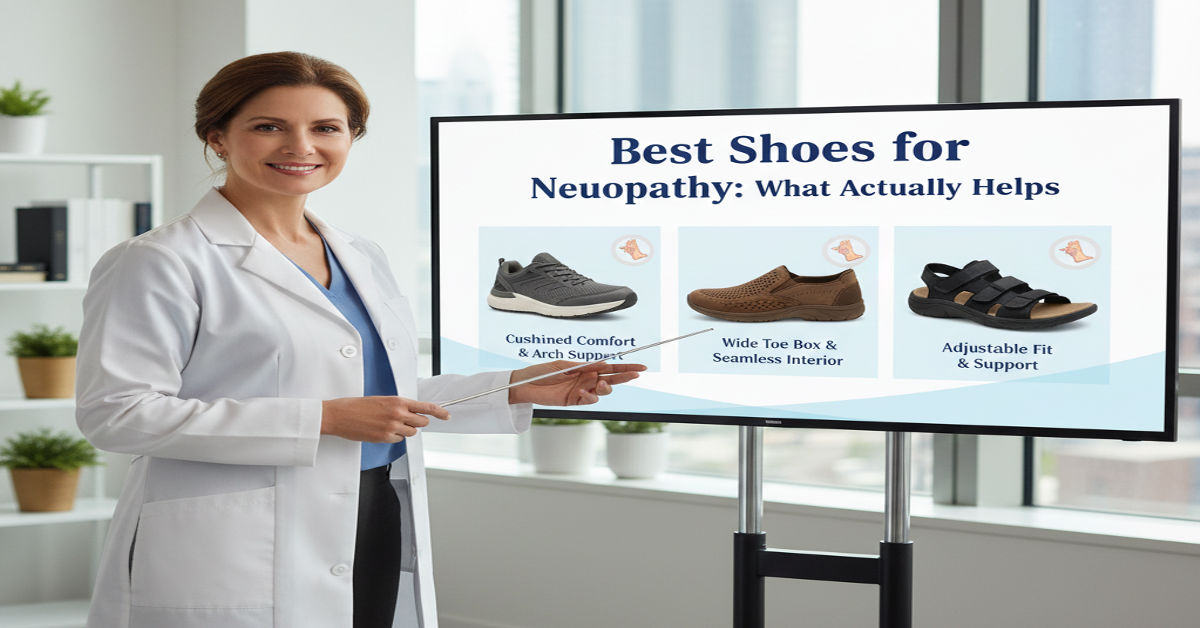
Peripheral neuropathy rarely announces itself all at once. It begins quietly — a tingling in the toes, a burning sensation at night, numbness that feels like wearing invisible socks. For many of the nearly 30 million Americans affected, according to the National Institutes of Health, the pain and loss of sensation eventually reshape daily life. Walking becomes cautious. Balance erodes. Shoes, once an afterthought, become a central medical decision.
In the first moments of searching for “best shoes for neuropathy,” people are usually asking a more urgent question: Can walking hurt less? The short answer is yes — but only with the right combination of support, protection and fit. Neuropathy-friendly shoes do not cure nerve damage, but evidence shows they can significantly reduce pain, prevent injuries and slow complications, particularly for those with diabetic neuropathy.
This article examines what makes a shoe suitable for neuropathy, why popular styles often fail, and which design features matter most according to podiatrists, neurologists and clinical research. It also looks at how footwear intersects with fall prevention, ulcer risk and quality of life — issues that rarely appear in glossy shopping guides.
Rather than offering a simple “top ten” list, this long-form guide explains how to choose shoes based on neuropathy type, symptom severity and daily use. The goal is not fashion or hype, but function, safety and dignity — walking without fear of pain or injury.
Why Neuropathy Changes the Rules of Footwear
Peripheral neuropathy alters how the brain receives signals from the feet. Sensory nerves misfire or go silent, meaning pressure points, heat, friction and minor injuries may go unnoticed. According to the Mayo Clinic, this loss of protective sensation dramatically increases the risk of blisters, ulcers and infections, especially in people with diabetes.
Shoes designed for healthy feet often emphasize flexibility and minimal structure. For neuropathy, that flexibility can become dangerous. Thin soles transmit ground shock directly to already-irritated nerves. Narrow toe boxes compress toes that may already be clawing due to muscle imbalance. Seams rub against skin that cannot properly signal distress.
Dr. A. Lee Dellon, a peripheral nerve surgeon and founder of the Dellon Institutes for Peripheral Nerve Surgery, has emphasized that reducing repetitive mechanical stress on nerves is a critical — and often overlooked — part of neuropathy management. Footwear, he notes, is “a constant interface between the body and the environment.”
Neuropathy also affects proprioception, the sense of where the body is in space. Shoes with unstable platforms or excessive cushioning can increase fall risk, particularly among older adults. As a result, neuropathy footwear must strike a careful balance: enough cushioning to absorb shock, enough structure to stabilize gait.
The Medical Priorities Shoes Must Address
For clinicians, the question is not brand loyalty but risk reduction. Podiatrists and neurologists consistently point to four medical priorities when recommending shoes for neuropathy: pressure redistribution, protection, stability and accommodation of deformities.
Pressure redistribution is essential because high-pressure points — under the metatarsal heads or heel — are where ulcers most often form. Research published in Diabetes Care has shown that therapeutic footwear can reduce plantar pressure by 30 to 50 percent when properly fitted.
Protection involves shielding the foot from external trauma. Thick, firm outsoles prevent sharp objects from penetrating, while padded collars protect fragile ankles. Stability relates to a firm heel counter and low heel-to-toe drop, reducing lateral motion that can lead to falls.
Accommodation means space. Neuropathy frequently coexists with bunions, hammertoes and swelling. Shoes must allow for orthotics, extra depth and fluctuating foot volume without creating friction.
As Dr. Kristin Titko, a board-certified podiatrist quoted by the American Podiatric Medical Association (APMA), has explained, “Footwear is part of medical treatment, not an accessory, for patients with nerve damage.”
Essential Features of the Best Shoes for Neuropathy
| Feature | Why It Matters | What to Look For |
| Wide toe box | Prevents compression and friction | Rounded or anatomical shape |
| Extra depth | Accommodates orthotics and deformities | Removable insoles |
| Firm heel counter | Improves stability | Minimal heel collapse |
| Cushioned midsole | Reduces shock to nerves | EVA or polyurethane |
| Seamless interior | Prevents skin irritation | Hand-inspected lining |
These features are not marketing buzzwords; they correspond directly to clinical risks. A wide toe box reduces shear forces that cause calluses. Extra depth allows custom orthotics prescribed for diabetic neuropathy, which Medicare has covered under the Therapeutic Shoe Bill since 1993.
Materials also matter. Leather and engineered mesh adapt better to foot shape than stiff synthetics. Adjustable closures — laces, Velcro or BOA systems — allow fine-tuning throughout the day as swelling changes.
Importantly, “soft” does not mean “unstable.” Overly plush shoes without structure can worsen balance problems. The best neuropathy shoes feel secure, not spongy.
Athletic Shoes: Often the Safest Starting Point
Running and walking shoes dominate neuropathy recommendations for a reason: they are engineered for repetitive impact and motion control. Brands that offer wide and extra-wide sizes, removable insoles and rocker soles tend to perform best in clinical evaluations.
A 2020 review in Journal of Foot and Ankle Research found that rocker-bottom soles reduced forefoot pressure in people with diabetic neuropathy, improving walking comfort without increasing fall risk when paired with a firm heel.
Walking shoes with moderate stiffness help guide the foot through gait, compensating for lost sensory feedback. Neutral running shoes often outperform minimalist designs, which lack sufficient cushioning and protection.
However, athletic shoes are not universally ideal. For people with severe balance impairment, overly thick midsoles can raise the center of gravity. For others, the casual aesthetic may limit use in professional settings — an issue that has driven innovation in therapeutic dress shoes.
Therapeutic and Medical-Grade Shoes
Medical-grade shoes, often prescribed for diabetic neuropathy, are designed to meet specific reimbursement and safety standards. Under Medicare guidelines, qualifying patients can receive one pair of depth shoes and three pairs of custom inserts per year.
These shoes emphasize extra depth, minimal seams and compatibility with orthoses. While historically criticized for bulky aesthetics, newer designs increasingly resemble standard footwear.
Dr. Andrew Boulton, a professor of medicine at the University of Manchester and a leading diabetic foot researcher, has stated that “proper footwear is the cornerstone of ulcer prevention” for neuropathy patients — a position echoed in international diabetic foot guidelines.
The downside is access. Not all patients qualify for coverage, and out-of-pocket costs can exceed $150 to $300 per pair. Still, for individuals with prior ulcers or severe deformities, medical-grade shoes are often non-negotiable.
Sandals, Slippers and the Hidden Dangers at Home
Neuropathy-related injuries frequently occur indoors. Barefoot walking and flimsy slippers expose numb feet to burns, cuts and blunt trauma. Even sandals can be risky if they lack full-foot coverage and secure straps.
That said, neuropathy-friendly sandals do exist. They feature closed toes, contoured footbeds and adjustable straps at multiple points. The APMA has awarded its Seal of Acceptance to several such designs, indicating they promote foot health when used appropriately.
House shoes deserve similar scrutiny. Supportive slippers with rubber outsoles and firm heel cups reduce fall risk on stairs and hard floors. Memory foam alone is insufficient; it compresses unevenly and provides little guidance for gait.
As Dr. Jeffrey Decker, a podiatrist quoted in Diabetes Self-Management magazine, warned, “Most foot injuries I see in neuropathy patients happen at home, not outside.”
Comparing Shoe Types by Neuropathy Severity
| Neuropathy Severity | Recommended Shoe Type | Avoid |
| Mild tingling | Cushioned walking shoes | Minimalist shoes |
| Moderate pain/numbness | Stability running shoes | High heels |
| Severe numbness | Medical-grade depth shoes | Flip-flops |
| Balance impairment | Firm-soled walking shoes | Platform soles |
Matching shoe type to symptom severity is crucial. What feels comfortable in early neuropathy may become dangerous as sensation declines. Regular reassessment — at least annually — is recommended by diabetic foot care guidelines.
Orthotics: When Shoes Are Not Enough
Shoes alone cannot correct abnormal pressure distribution caused by nerve damage. Custom orthotics, prescribed by podiatrists, play a central role in offloading high-risk areas. Total contact inserts, for example, are designed to maximize surface area contact and minimize peak pressure.
A landmark study published in The Lancet in 2004 demonstrated a significant reduction in ulcer recurrence when therapeutic footwear and custom orthoses were used together. The effect was strongest when patients consistently wore the prescribed shoes.
Off-the-shelf insoles may help mild symptoms, but they rarely provide adequate correction for advanced neuropathy. Importantly, orthotics must fit the shoe; otherwise, they create new pressure points.
What Marketing Gets Wrong
The explosion of “comfort shoes” has muddied the waters. Plush insoles, celebrity endorsements and vague claims of “pain relief” often obscure the absence of medical design features. Softness without structure, or style without fit options, can worsen neuropathy symptoms.
Another misconception is that expensive automatically means better. While quality materials matter, the best shoe is the one that fits your foot shape, accommodates orthotics and supports stable walking.
Neuropathy also changes over time. Shoes that worked last year may no longer suffice. Experts consistently emphasize fit checks, gait assessment and periodic replacement — typically every 300 to 500 miles for walking shoes.
Takeaways
- Neuropathy-friendly shoes reduce pain, prevent injuries and lower ulcer risk.
- Wide toe boxes, extra depth and firm heel counters are non-negotiable features.
- Athletic walking shoes are often safest, but medical-grade shoes are essential for severe cases.
- Sandals and slippers require the same scrutiny as outdoor footwear.
- Custom orthotics significantly improve outcomes when paired with proper shoes.
- Comfort marketing often ignores stability and protection.
- Regular reassessment is critical as neuropathy progresses.
Conclusion
Choosing the best shoes for neuropathy is not about chasing the latest trend or finding a miracle cure. It is about respecting the altered biology of the foot — the nerves that no longer signal danger, the muscles that pull unevenly, the skin that heals slowly. Good shoes do not restore lost sensation, but they stand in for it, absorbing shock, redistributing pressure and protecting against unseen harm.
For many patients, the right footwear marks a turning point: fewer nightly pain flares, more confident steps, less fear of falling or injury. Clinicians increasingly recognize shoes as a form of preventive medicine, one that works only when worn consistently and chosen thoughtfully.
The challenge is access — to accurate information, to proper fitting, to affordable options. But the principle remains simple. When nerve pain complicates every step, shoes should not add to the burden. They should quietly, reliably make movement possible again.
FAQs
Can shoes really reduce neuropathy pain?
They cannot cure nerve damage, but proper shoes can significantly reduce pain by minimizing pressure, friction and impact on sensitive nerves.
Are barefoot shoes good for neuropathy?
No. Minimalist or barefoot shoes lack cushioning and protection, increasing injury and pain risk for people with reduced sensation.
How often should neuropathy shoes be replaced?
Typically every 6 to 12 months, depending on wear and walking volume. Loss of midsole support increases risk.
Do I need a prescription for therapeutic shoes?
For Medicare coverage in diabetic neuropathy, yes. A physician must certify medical necessity.
Are custom orthotics always necessary?
Not always. Mild neuropathy may respond to well-designed shoes alone, but advanced cases benefit greatly from custom inserts.
References
American Podiatric Medical Association. (2023). Diabetic foot care and footwear guidelines. https://www.apma.org
Bus, S. A., et al. (2020). Footwear and offloading interventions to prevent and heal foot ulcers in diabetes. Journal of Foot and Ankle Research, 13(1), 1–9. https://jfootankleres.biomedcentral.com
Mayo Clinic. (2024). Peripheral neuropathy: Symptoms and causes. https://www.mayoclinic.org
National Institute of Neurological Disorders and Stroke. (2023). Peripheral neuropathy fact sheet. https://www.ninds.nih.gov
U.S. Centers for Medicare & Medicaid Services. (2023). Therapeutic shoes for persons with diabetes. https://www.cms.gov