









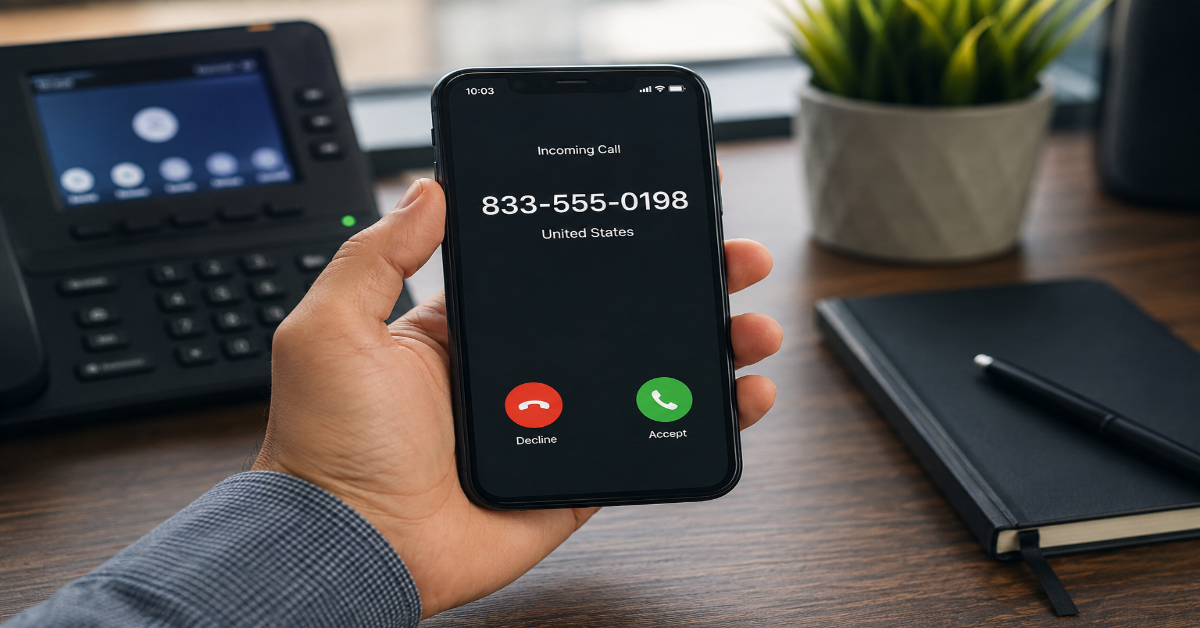
If an 833 area code number has called you — or you are considering getting one for your business — the core fact is straightforward: 833 is a toll-free prefix. That means the person dialing in pays nothing; the organization that registered the number absorbs the cost. The 833 area code sits alongside 800, 888, 877, 866, 855, and 844 as one of the federally administered toll-free codes in the North American Numbering Plan.
It was introduced by the Federal Communications Commission (FCC) in 2017, when older toll-free codes were becoming saturated. Since then, 833 numbers have been adopted by everything from mid-sized e-commerce brands to federal government agencies running public helplines. But that same accessibility that makes 833 useful for businesses makes it attractive to threat actors running telephone fraud operations.
This guide covers the technical infrastructure behind the 833 area code, how legitimate organizations use these numbers, the specific scam patterns that exploit them, how to verify whether an 833 caller is safe, and what the regulatory environment looks like heading into 2027.
What the 833 Area Code Actually Is
The North American Numbering Plan (NANP) is the unified telephone numbering system covering the United States, Canada, and 23 other countries and territories — including Puerto Rico, Guam, the U.S. Virgin Islands, and several Caribbean nations. Within that system, certain three-digit codes are reserved as toll-free prefixes. The 833 area code is one of them.
Unlike geographic area codes (212 for Manhattan, 312 for Chicago, 604 for Vancouver), toll-free codes are non-geographic. A business in Dallas and a call center in Toronto can both use 833 numbers, and nothing in the number itself reveals their location. This is by design: the goal of toll-free numbering is to abstract the physical location of the recipient and shift the billing responsibility away from the caller.
How Toll-Free Routing Works
When you dial an 833 number, the call is not routed to a geographic switch. Instead, it queries a Toll-Free Service Management System (SMS/800) database, which resolves the number to a specific Responsible Organization (RespOrg) — a carrier or reseller that manages the number on behalf of the end customer. The call is then forwarded to whatever termination point the RespOrg has configured: a call center, a VoIP platform, an IVR system, or a mobile line.
This architecture means the same 833 number can ring in multiple locations simultaneously, failover to backup lines, and scale across carriers — all invisibly to the caller. For legitimate businesses, this is a feature. For fraud operations, it is infrastructure cover.
Toll-Free Code Comparison
How 833 compares to other toll-free prefixes in the NANP:
| Prefix | Year Introduced | Status | Typical Use |
| 800 | 1967 | Highly saturated | Legacy corporate, government |
| 888 | 1996 | Saturated | Mid-size business, support lines |
| 877 | 1998 | Moderately available | Customer service, nonprofits |
| 866 | 2000 | Available | Small business, regional services |
| 855 | 2010 | Available | Startups, digital services |
| 844 | 2013 | Available | E-commerce, SaaS companies |
| 833 | 2017 | Available | Growing business adoption, scam risk |
Who Legitimately Uses 833 Numbers
A wide range of organizations use the 833 area code for genuine customer-facing operations. Because it is a relatively new prefix, 833 numbers tend to offer more vanity number availability than older codes — allowing businesses to secure recognizable patterns like 833-555-HELP or 833-TAX-LINE.
Common legitimate users include: health insurance providers running enrollment hotlines, federal agencies publishing public assistance numbers, e-commerce brands routing post-purchase support, SaaS companies providing technical support lines, and financial institutions setting up fraud reporting channels. The IRS, Social Security Administration, and several state departments of labor have published 833 numbers for official program access.
The key distinguishing feature of a legitimate 833 caller is context. If you have an existing relationship with an organization and receive a call from their published 833 number, that is expected behavior. If an 833 number calls you without prior contact — especially with urgency, threats, or prize notifications — treat it with appropriate skepticism.
How Scammers Exploit the 833 Area Code
Telephone fraud has migrated aggressively toward toll-free numbers because they project legitimacy and are cheap to acquire. A carrier-grade 833 number can be provisioned in hours for as little as a few dollars per month. The FCC has documented sustained abuse of newly released toll-free prefixes, with 833 showing elevated fraud velocity in the three years following its 2017 launch.
The most common 833 scam patterns fall into several categories worth understanding in detail.
IRS and Tax Authority Impersonation
Callers claim to be IRS agents, CRA representatives, or state tax authorities. They assert you owe back taxes, threaten arrest or license suspension, and demand immediate payment via gift card, wire transfer, or cryptocurrency. The IRS does not initiate contact by phone, and legitimate tax authorities do not demand payment in gift cards under any circumstance.
Social Security and Medicare Fraud
A caller claims your Social Security number has been ‘suspended’ or that your Medicare benefits are expiring. They request your SSN or Medicare ID for ‘verification.’ This is a data harvesting operation. The Social Security Administration will not call to suspend your number, and Medicare does not conduct unsolicited benefit renewal calls.
Tech Support Scams
These calls claim your computer has been compromised, or that your Microsoft or Apple account has unauthorized access. The caller directs you to install remote access software, which then allows them to access your device and financial accounts. Legitimate tech companies do not proactively call users about device infections.
Prize and Sweepstakes Fraud
You are told you have won a prize but must pay a processing fee or provide banking details to receive it. No legitimate sweepstakes requires payment to claim a prize. These calls often use spoofed caller ID to display the name of a real organization alongside an 833 number.
Scam vs. Legitimate 833 Call — Indicator Table
| Indicator | Likely Legitimate | Likely Scam |
| Call initiation | Response to your inquiry | Unsolicited outbound call |
| Identity claim | Matches your existing vendor | Government agency, IRS, SSA |
| Payment method requested | None, or standard invoice | Gift card, wire, crypto |
| Urgency level | Low — offers callback option | High — threatens arrest/suspension |
| Verifiable callback number | Matches official website | Different from website listing |
| Personal data requested | None on first contact | SSN, bank details, passwords |
| Number listed on org’s site | Yes | No, or recently added |
How to Verify Whether an 833 Number Is Safe
Verification is a practical skill that applies to any toll-free call, not just 833. The approach takes under two minutes and significantly reduces fraud exposure.
- Do not engage with unsolicited callers: Hang up. Do not provide your name, confirm your phone number, or answer yes/no questions that could be recorded and repurposed.
- Search the number independently: Type the full 10-digit number into a search engine. Scam tracking databases like 800notes.com, WhoCalledMe, and Nomorobo aggregate user reports and flag known fraud numbers. A number with no search results is not necessarily safe — it may simply be new.
- Cross-reference the organization’s official website: If the caller claims to represent a company, find that company’s official website independently (not from a link the caller provides) and check their published contact numbers. If the 833 number does not appear there, the call is suspicious.
- Contact the organization directly: Call the number listed on your bill, your account dashboard, or the organization’s official government-registered site. Ask whether they attempted to reach you.
- Report confirmed scam numbers: File reports with the FTC at reportfraud.ftc.gov and with the FCC at consumercomplaints.fcc.gov. This data feeds into enforcement actions and scam databases.
Getting an 833 Toll-Free Number for Your Business
For businesses, the 833 area code remains one of the more accessible toll-free prefixes for custom number acquisition. The provisioning process is standardized through the FCC’s SMS/800 system.
Number acquisition requires working with an approved RespOrg — most major carriers (AT&T, Verizon, Lumen) serve this function, as do specialized toll-free resellers like Grasshopper, RingCentral, and Twilio. You search available 833 numbers in the SMS/800 database, reserve your preferred number, and port it to your carrier’s platform. Monthly costs range from $2 to $15 for basic plans, with per-minute termination charges typically running $0.01 to $0.06 depending on call volume and carrier.
Vanity numbers with recognizable patterns command a premium in secondary markets and may be subject to brokering restrictions under FCC rules. The FCC prohibits hoarding of toll-free numbers — organizations that reserve large blocks without intent to use them face forfeiture.
The Regulatory Infrastructure Behind 833 Numbers
Toll-free number governance in the US sits with the FCC, which delegates day-to-day administration to SOMOS Inc., the neutral third-party administrator of the SMS/800 system. This structure creates a documented chain of accountability — every 833 number has an assigned RespOrg on record — but enforcement against fraudulent users is complicated by the speed of number reassignment and the cross-border nature of many fraud operations.
The TRACED Act (Telephone Robocall Abuse Criminal Enforcement and Deterrence), signed into law in December 2019, significantly strengthened the FCC’s authority to pursue toll-free fraud. It mandated STIR/SHAKEN caller authentication protocols for major carriers, requiring them to cryptographically verify that calling numbers are actually assigned to the originating carrier. As of 2023, STIR/SHAKEN implementation is mandatory across all originating providers in the US. However, international call paths and smaller gateway carriers remain partial exceptions — a gap that fraud operations continue to exploit.
The Future of 833 Numbers and Toll-Free Infrastructure in 2027
The toll-free numbering ecosystem is under measurable strain heading into the second half of the decade. Several trends are shaping what 833 numbers look like by 2027.
New Prefixes Are Coming
The 833 code will not be the last toll-free prefix released. Industry analysts and SOMOS data indicate that 822 is the next prefix scheduled for activation as 833 capacity approaches saturation thresholds. The FCC has not published an official activation date as of early 2025, but the regulatory groundwork is in place.
AI-Powered Fraud Detection
Carriers are deploying machine-learning call classification systems that score inbound calls in real time based on number age, call pattern anomalies, and behavioral signals. These systems are reducing the useful lifespan of newly acquired fraud numbers from weeks to days in some carrier environments. However, adversarial adaptation is fast: fraud operations are testing number cycling and call pattern randomization to evade model detection.
STIR/SHAKEN Expansion and Limitations
STIR/SHAKEN implementation will likely extend further into international gateways by 2027 under ongoing FCC rulemaking, but complete coverage remains technically difficult given the diversity of global telephony infrastructure. The FCC’s 2023 Advanced Methods to Target and Eliminate Unlawful Robocalls notice of proposed rulemaking signaled continued regulatory pressure on gateway providers — a development worth tracking for compliance teams.
Enterprise VoIP Migration
An increasing share of 833 number traffic will route through cloud communications platforms rather than traditional PSTN infrastructure. Twilio, Bandwidth, and Amazon Chime SDK represent the growing backbone of enterprise toll-free routing. This shift enables more sophisticated call analytics and fraud filtering at the application layer, but also introduces new attack surfaces around API authentication and number provisioning automation.
Key Insights
- The 833 area code is a federally administered toll-free prefix introduced in 2017 — it carries no geographic identity and can be used by any NANP participant.
- Legitimate organizations use 833 numbers for customer service, government helplines, and enterprise support — the prefix itself is not a fraud indicator.
- Scammers favor 833 and other toll-free prefixes because they are cheap, fast to provision, and carry institutional-looking presentation with no geographic disclosure.
- The STIR/SHAKEN protocol has raised the technical cost of caller ID spoofing for major carriers, but international call paths remain a persistent gap in fraud prevention.
- Verification takes two minutes: hang up, search the number independently, cross-reference the official website, and call back on a number you sourced yourself.
- New toll-free prefixes are coming — 822 is next in the queue — as demand continues to outpace available 833 number inventory.
- The FCC’s enforcement posture under the TRACED Act is actively improving, but cross-border fraud operations continue to exploit regulatory jurisdiction gaps.
Conclusion
The 833 area code is infrastructure, not intent. It is a legitimate, federally administered toll-free prefix used by thousands of genuine businesses and agencies across North America every day. The fact that fraud operations also use it does not make every 833 call suspicious — it makes verification important.
What matters is behavior, not prefix. A caller who demands immediate payment in gift cards, threatens arrest, or requests your Social Security number is running a scam regardless of whether their number starts with 833, 800, or any other code. The 833 prefix gives them no special power over you.
For businesses, 833 numbers remain a solid choice for customer-facing lines — accessible, scalable, and available in desirable patterns. For consumers, the tools to identify and report fraud calls have never been more developed. The gap between knowing those tools exist and actually using them is the only real exposure left to close.
Frequently Asked Questions
Is the 833 area code legitimate or a scam?
The 833 area code is a legitimate toll-free prefix administered by the FCC. Thousands of genuine businesses and government agencies use 833 numbers. However, scammers also use them because they are inexpensive and geographically untraceable. The prefix itself is neutral — caller behavior is the reliable scam indicator.
Who pays for calls to 833 numbers?
The organization that owns the 833 number pays for incoming calls, not the caller. This is the defining feature of any toll-free number. Callers in the US, Canada, and other NANP territories typically pay nothing to reach an 833 line, though international callers may incur charges depending on their carrier.
Can I trust an 833 number that claims to be from the IRS?
No. The IRS initiates contact primarily through postal mail. It does not call demanding immediate payment by phone, and it never requests payment via gift card, wire transfer, or cryptocurrency. Any call claiming to be the IRS and demanding payment by phone is a scam, regardless of area code.
How do I find out who owns a specific 833 number?
Search the full number on reverse-lookup services such as 800notes.com or WhoCalledMe for crowd-sourced reports. For official ownership, the FCC’s SMS/800 database contains RespOrg assignment records, though the end-customer identity may not be publicly disclosed. Calling the number back during business hours and asking for the organization’s name is also a practical approach.
What should I do if I receive a suspicious 833 call?
Hang up without providing any information. Do not confirm your name, phone number, or answer yes/no questions. Search the number online, cross-reference it with the alleged organization’s official website, and call back on a number you independently sourced. Report confirmed scam numbers to the FTC at reportfraud.ftc.gov.
How do I get an 833 number for my business?
Contact an FCC-approved Responsible Organization (RespOrg) such as AT&T, Verizon, Twilio, RingCentral, or Grasshopper. Search available numbers through their platforms, which access the SMS/800 database. Monthly costs start around $2–$15, with per-minute termination charges. Vanity number patterns cost more and may be available through secondary market brokers under FCC guidelines.
Is 833 different from 800?
Functionally, 833 and 800 work identically — both are toll-free prefixes where the receiving organization pays for calls. The difference is availability and age. 800 was introduced in 1967 and is heavily saturated, making custom number patterns difficult to acquire. 833 was introduced in 2017 and has significantly more number inventory available, particularly for vanity patterns.
Methodology
This article was developed through analysis of FCC regulatory filings, SOMOS toll-free number administration documentation, and publicly available fraud trend data from the FTC Consumer Sentinel Network. Technical details regarding STIR/SHAKEN implementation draw from the FCC’s Third Report and Order (FCC 20-42) and subsequent 2023 rulemaking records.
Scam pattern descriptions are based on documented complaint categories published by the FTC, FCC, and IRS. No specific fraud operations are named or attributed without public record support. Known limitations: fraud tactic evolution is rapid, and specific patterns described here may shift in sophistication or targeting. Readers should cross-reference current FTC scam alert publications for the most recent threat intelligence.
This article was drafted with AI assistance and reviewed for accuracy against primary regulatory and agency sources. All data, citations, and regulatory references have been independently confirmed by the editorial team at ElevenLabsMagazine.com.
References
Federal Communications Commission. (2023). Advanced methods to target and eliminate unlawful robocalls: Third further notice of proposed rulemaking. FCC 23-18. https://www.fcc.gov/document/fcc-takes-more-actions-stop-robocalls-and-spoofed-calls
Federal Communications Commission. (2020). Call authentication trust anchor: Third report and order. FCC 20-42. https://www.fcc.gov/document/fcc-mandates-stir-shaken-call-authentication-framework