










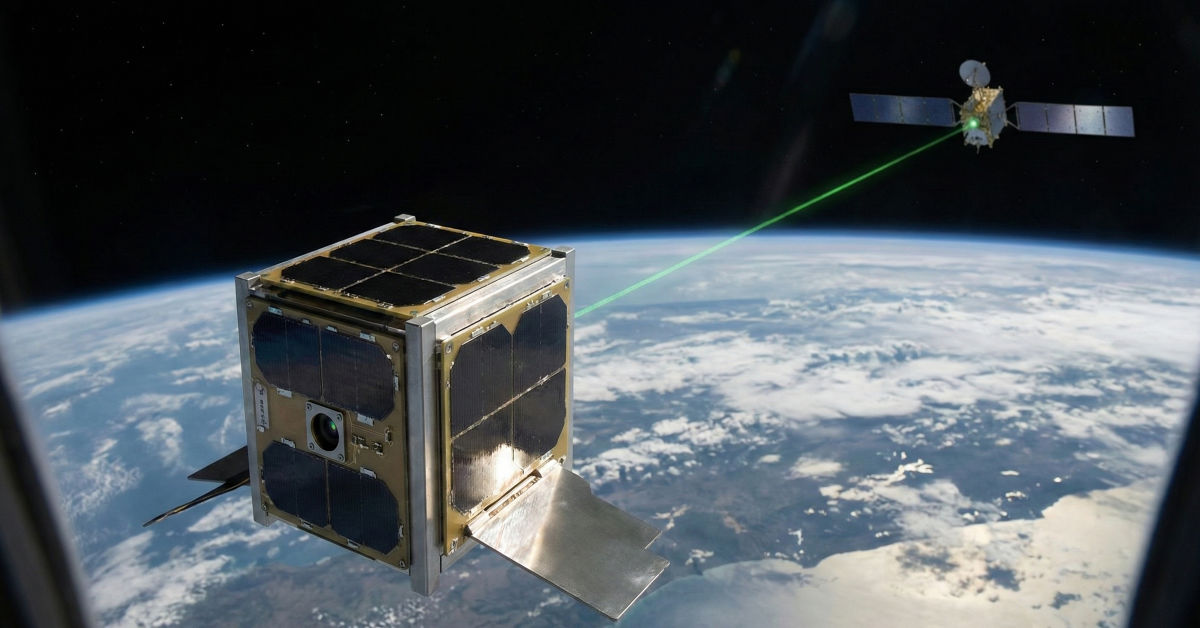
In an era dominated by radio‑frequency (RF) satellite communication, a modest 2‑watt laser perched on a satellite 36,000 kilometres above Earth has achieved something remarkable: transmitting data at 1 gigabit per second (Gbps). Using roughly the power of a nightlight, this laser beam has successfully bridged the vast distance of geostationary orbit, piercing through Earth’s turbulent atmosphere to deliver data faster than many conventional satellite internet connections 2 Watt Laser Satellite Communication.
The significance of this demonstration lies not only in the raw speed but in the efficiency. If such low-power optical links can be deployed reliably, they promise a future of global connectivity, enhanced deep‑space telemetry, and high-volume data transfer from satellites without the need for massive power sources or large antenna systems. This article explores the science behind 2‑watt laser satellite communication, its technological breakthroughs, the potential applications, and the challenges that remain for practical implementation.
The 2‑Watt Breakthrough
In 2025, researchers successfully demonstrated a geostationary satellite transmitting 1 Gbps using only a 2‑watt laser. This achievement challenges long-held assumptions that high-power lasers or large dishes are essential for long-distance satellite communication. The system relied on two key technologies — adaptive optics (AO) and mode-diversity reception (MDR) — to counteract atmospheric interference and signal distortion.
| Parameter | Value |
| Laser power | 2 watts |
| Satellite altitude | ~36,000 km (geostationary) |
| Achieved data rate | 1 Gbps |
| Speed vs. traditional RF links | ~5× faster |
By combining precise optical engineering with adaptive signal recovery techniques, the researchers were able to create a compact, low‑power 2 Watt Laser Satellite Communication system capable of high data throughput, marking a significant milestone in satellite technology.
Advantages of Laser Satellite Communication
Laser satellite communication, or “lasercom,” offers multiple benefits over traditional radio‑frequency methods:
- Higher bandwidth: Laser beams can transmit more data per unit of time, providing faster and more efficient links.
- Lower size, weight and power: Lasercom terminals are compact and energy-efficient, freeing satellite payload for other instruments.
- Narrow beam, high security: Focused laser beams are harder to intercept, reducing interference and increasing communication security.
- Scalability: Smaller satellites can adopt lasercom, enabling flexible constellations with high capacity.
Experts note that lasercom systems can improve communication performance by up to 100 times compared to RF systems without increasing power consumption or satellite mass, making them ideal for modern satellite networks. This makes 2 Watt Laser Satellite Communication not just feasible — but potentially transformative.
The Technology Behind the 2‑Watt Laser
Adaptive Optics
Atmospheric turbulence can distort or scatter laser signals traveling from orbit to Earth. Adaptive optics corrects these distortions in real-time by adjusting an array of micro‑mirrors to focus the incoming light. This ensures that even a faint laser beam can be accurately detected at ground stations, maintaining signal quality over thousands of kilometers. The use of AO, borrowed from astronomy applications, has become pivotal for practical laser satellite communication.
Mode‑Diversity Reception
Even with AO correction, some distortion and scattering persist — causing portions of the laser beam to deviate or fragment. Mode‑diversity reception (MDR) captures light scattered across multiple spatial modes, then reconstructs the original signal by combining those channels. In essence, MDR recovers the integrity of a distorted beam, reducing errors and enabling stable high-speed communication despite atmospheric disturbances.
When combined — as AO‑MDR synergy — these two technologies allow a low-power laser to punch far above its weight, making 2 Watt Laser Satellite Communication a reality rather than a theoretical possibility.
| Technology | Function |
| Adaptive Optics (AO) | Corrects atmospheric distortion in real time |
| Mode‑Diversity Reception (MDR) | Reconstructs scattered signals to reduce errors |
| AO‑MDR synergy | Enables 2‑watt laser to maintain 1 Gbps link from GEO |
Historical Development
The road to low-power laser communication has been paved by decades of research:
- Early experiments (1990s): Pioneering ground-to-space laser communication linked Earth and orbiting platforms using pulsed lasers. These initial trials demonstrated feasibility but were limited in data rate and reliability.
- Inter‑satellite laser links (mid-2000s): The Japanese satellite OICETS (also known as “Kirari”) successfully established optical communication with the European satellite ARTEMIS. This validated inter‑satellite laser links and laid the foundation for space-based data relays.
- Advances in AO and compact laser terminals (2010s–2020s): As adaptive optics matured and compact, lower‑power, high‑efficiency laser transmitters emerged, space agencies and companies began exploring lasercom for small satellites, Earth observation, and deep-space missions.
- 2025 milestone — 2‑Watt demonstration: The first verified instance of a geostationary satellite using a 2‑watt laser to downlink at 1 Gbps, showing that high-bandwidth, low-power optical communication from high orbit is achievable.
Each step built on the last, moving from bulky, power-hungry systems to lean, efficient optical links. The new 2‑watt approach represents a culmination of decades of engineering, bringing laser satellite communication to a new threshold.
Challenges and Limitations
While laser satellite communication offers many advantages, several obstacles must be addressed:
| Challenge | Description |
| Atmospheric interference | Clouds, fog, and turbulence can disrupt or block the laser beam entirely. Rain, dust or air pollution further impede reliable communications. |
| Precision pointing | Because laser beams are narrow, satellites and ground stations must maintain extremely precise alignment. Even small drift can break the link. |
| Ground‑station requirements | Ground receivers need large, sensitive optical telescopes and clear atmospheric windows — infrastructure that may not be available everywhere. |
| Reliability and availability | Because links depend on weather and line-of-sight, optical communication may be intermittent. For continuous service, multiple ground sites and hybrid RF backup may be needed. |
| Scalability and cost | Building and maintaining a global network of optical ground stations and integrating lasercom across many satellites remains complex and potentially expensive. |
Because of these challenges, many experts expect 2‑watt laser satellite communication to complement, rather than fully replace, RF satellite networks — with hybrid systems switching between optical and radio links depending on conditions.
Applications and Implications
Laser communication could transform multiple domains:
- Global connectivity: With lean, high-capacity links, fewer geostationary satellites — equipped with low-power lasers — could deliver broadband access to remote or underserved areas, reducing reliance on large satellite constellations.
- Deep‑space telemetry and science missions: High-resolution Earth observation satellites, lunar platforms, and interplanetary probes produce massive data. Lasercom can downlink this data efficiently without heavy transmitters, enabling richer science returns.
- Small-satellite networks: Compact “smallsats” or CubeSats can integrate laser terminals, enabling high-speed inter-satellite or ground links without bulky hardware. This democratizes access to advanced communications for smaller players.
- Secure and resilient communication: Narrow, focused laser beams are harder to detect or intercept, offering advantages for secure military, governmental, or commercial data links — especially in contested or congested environments.
- Sustainable satellite infrastructure: Low-power systems reduce energy consumption and thermal load, enabling lighter satellites and potentially lowering launch and operational costs.
The 2‑watt laser demonstration underscores how laser satellite communication may redefine the economics, security, and capabilities of satellite-based connectivity.
Expert Perspectives
Dr. Emily Zhang, a satellite systems engineer, states:
“This demonstration proves that optical links can achieve remarkable efficiency. The key is managing atmospheric distortion with advanced optics.”
Prof. Robert Chen, a specialist in space communication systems, notes:
“Low‑power laser links challenge traditional assumptions about satellite design: you no longer need a heavy dish or high transmitter power to get high data rates. That opens new possibilities for smaller, more agile constellations.”
Dr. Sandra Lee, a researcher in free-space optical communication, adds:
“The AO‑MDR combination is elegant. It allows a tiny laser to overcome turbulence, which historically limited free-space optical communication from high orbits.”
These comments reinforce that 2‑watt laser satellite communication isn’t just a proof of concept — it may point toward a new paradigm in how we build and deploy satellite networks.
Takeaways
- 2‑watt laser satellite communication shows that a modest 2‑watt laser can deliver 1 Gbps from geostationary orbit.
- Key technologies — adaptive optics and mode‑diversity reception — enable high-speed, low-power links by correcting atmospheric distortion and reconstructing distorted signals.
- Lasercom offers better bandwidth, lower size/weight/power, tighter security, and scalability compared to traditional RF systems.
- Practical deployment remains challenged by atmospheric conditions, precision pointing, and the need for ground-station infrastructure.
- Real-world applications could transform broadband access, deep-space data transmission, small-satellite networks, and secure communication for governments and enterprises.
Conclusion
The 2‑watt laser satellite communication breakthrough marks a milestone in space‑based connectivity. It shows that high-bandwidth, energy-efficient communication from high orbit — once considered the domain of powerful transmitters and massive antennas — is now possible with a humble, compact optical system. By combining adaptive optics with mode-diversity reception, engineers overcame atmospheric turbulence and established a reliable optical link at unprecedented low power of 2‑Watt Laser Satellite Communication.
Still, whether lasercom becomes mainstream depends on solving practical challenges — building robust ground infrastructure, ensuring link reliability under varied weather, and integrating hybrid RF-optical communication strategies. If those obstacles can be navigated, low‑power laser satellite communication has the potential to revolutionize global internet delivery, satellite science, small‑sat constellations, and secure communications. This milestone could well be a harbinger of a new, leaner era in how humanity connects across — and beyond — the globe.
FAQs
What is laser satellite communication?
It uses focused light beams (often near-infrared lasers) to transmit data between satellites or from satellite to ground stations, offering higher bandwidth than conventional RF links.
Why is 2 watts significant?
Two watts is a very low power level — comparable to a nightlight. Showing that such a low-power laser can send 1 Gbps from geostationary orbit proves that high-bandwidth communication doesn’t always require bulky, power-hungry transmitters.
What makes lasercom challenging?
Atmospheric turbulence, weather conditions (clouds, fog, rain), and air pollution can scatter or block the beam. Also, laser links require extreme precision in pointing and high-quality ground stations with optical telescopes.
Can lasercom replace RF satellite networks entirely?
Not yet. Most experts expect hybrid systems — using lasercom when conditions are favorable, and RF as backup when optical links are unreliable.
What could 2‑watt laser satellite communication enable beyond internet access?
Efficient downlink of large scientific datasets from Earth‑observation satellites, high-bandwidth telemetry for deep-space missions, data links for small-satellite constellations, and secure, hard-to-intercept communication for governments or private networks.
References
- Free-space optical communication. (n.d.). In Wikipedia. Retrieved from https://en.wikipedia.org/wiki/Free-space_optical_communication
- Adaptive optics. (n.d.). In Wikipedia. Retrieved from https://en.wikipedia.org/wiki/Adaptive_optics
- OICETS. (n.d.). In Wikipedia. Retrieved from https://en.wikipedia.org/wiki/OICETS
- Deep Space Optical Communications. (n.d.). In Wikipedia. Retrieved from https://en.wikipedia.org/wiki/Deep_Space_Optical_Communications